Bathroom design
Kids' bathroom renovation
A kids' bathroom renovation is designed for the room's hardest users and for the ages they will pass through in it. Start with scald protection at every tap, including the sink children use most, since Ontario caps hot water at a home's fixtures at 49 °C. Then plan a tub and hand shower for the bath-time years that converts to a teenager's shower, put tough finishes where the splashing actually lands, and build counters at adult height with a step instead of a low vanity that will need replacing.
Scald protection at every tap, not only the shower
A child's skin burns in about a quarter of the time adult skin does. Parachute, Canada's national injury prevention charity, notes that water at 60 °C, a temperature many Canadian homes run, can cause a third-degree burn in about one second, while at 49 °C it takes about 10 minutes. It recommends bath water no hotter than 38 °C for young children.
The Ontario Building Code requires electric storage water heaters to hold water at no less than 60 °C, which the Public Health Agency of Canada also recommends to keep bacteria such as Legionella in check, and then caps hot water delivered to fixtures in a home at 49 °C. Shower valves meet that cap with pressure-balanced or thermostatic designs and high-limit stops. The bathroom sink is easier to overlook, yet it is the tap a child turns on alone most often, so make sure the 49 °C limit reaches it too.
- Ask for the outlet temperature at the sink and tub to be measured with a thermometer at handover, not assumed from the setting.
| Device | Where it goes | Typical cost | Notes |
|---|---|---|---|
| Mixing valve at the water heater | On the hot outlet of the tank | About $100 to $150 | Covers the whole house, including the kitchen |
| Mixing valve on a branch | On the pipe feeding the kids' bathroom | About $100 to $150 | Protects one area; set during rough-in |
| Point-of-use mixing valve | Under the sink | About $100 to $150 | Protects the one tap it serves |
| Anti-scald or shut-off device | On or in place of a faucet or shower head | About $10 to $50 | Slows water to a trickle when it gets too hot |
| Thermostatic shower and tub valve | In the wall at the tub | Part of the valve choice | Holds a set temperature; see shower valves |
Plan the room for toddlers, school-age kids and teenagers
The same bathroom will see a toddler bathed by a parent, a nine-year-old showering alone and a teenager who wants twenty minutes and a mirror. Building for all three now is cheaper than rebuilding in six years. NKBA's bath planning figures give the dimensions for each stage.
| Stage | How the bathroom is used | Build in now |
|---|---|---|
| Toddler and preschool | Bathed in the tub by an adult kneeling alongside | A 60 in tub with about 30 in of clear floor along it; tub controls offset toward the room, within about 6 in of the front wall and around 33 in high |
| School age | Showers alone, reaches for the hand shower | A hand shower on a slide bar whose lowest position sits within 15 to 48 in of the floor; a valve they cannot set too hot |
| Teenager | Long showers, more products, getting ready at the mirror | Counter space, good mirror lighting and an exhaust fan sized and controlled for long showers |
Put the toughest finishes where the splashing lands
Children do not keep water inside the tub, so map where it ends up and finish those spots for it. Everything else can follow the look you want.
| Spot | What happens there | Finish that copes |
|---|---|---|
| Floor beside the tub | Standing water from bath time | Porcelain tile with a matte or textured face and a tile base instead of a wood baseboard |
| Wall beside and opposite the tub | Splashes beyond the surround | Tile carried past the tub to a wainscot height, or full height |
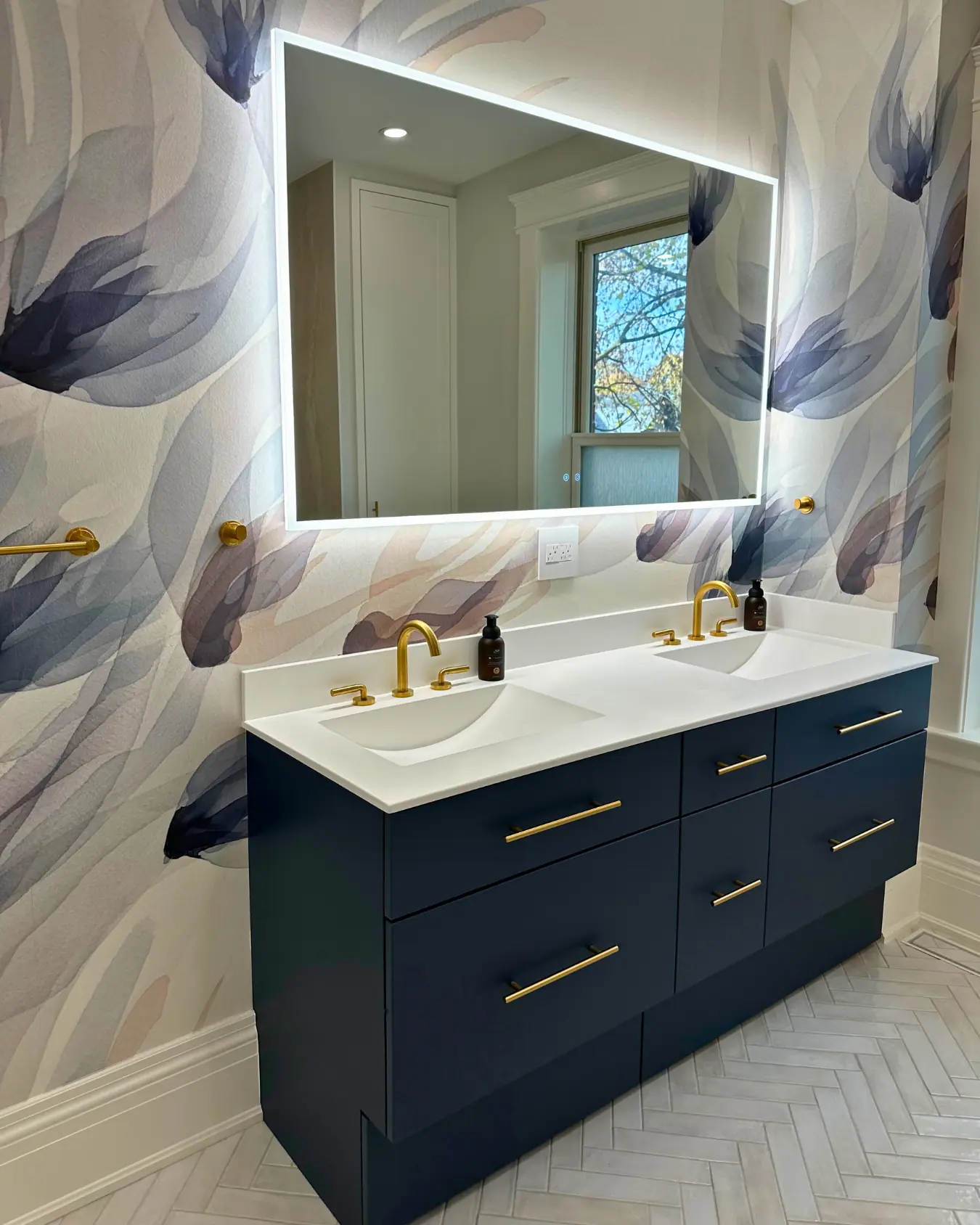
| Vanity top and sink | Toothpaste, soap and hair products | Quartz or solid surface with an integrated or undermount sink, so there is no rim to clean |
| Faucet | Wet hands, fingerprints, water spots | A single-lever faucet in a brushed finish |
| Around the toilet | Missed aim and mopping | A wall-hung or skirted toilet with tile behind it; see wall-hung toilets |
| Vanity doors and toe kick | Kicks, wet hands, bumps | Durable cabinet finishes and a recessed toe kick that hides scuffs |
Counter heights that work now and in ten years
NKBA puts a comfortable sink height for children at 26 to 32 inches, against 32 to 43 for adults, and suggests the sink rim sit about 3 inches below the user's elbow. A child-height vanity is outgrown in a few years, so most families build to adult height and close the gap with a step: a sturdy stool, or a step that folds out of the vanity's toe kick. Put the toilet paper holder where NKBA does, about 26 inches high and 8 to 12 inches in front of the bowl, and it suits every age.
If two children share the room, a second sink needs about 60 inches of vanity wall; double vanity bathroom layouts shows the widths.
Safety details for a room children use on their own
Once children use the bathroom without an adult, a few fittings matter more than any finish. The Public Health Agency of Canada's advice to cover unused electrical outlets and never leave a young child alone in the bath shapes the design as much as the parenting.
- Lock with an outside release: a privacy lock that can be opened from the hallway with a small key or tool.
- Outlets away from the tub: keep receptacles at the vanity, not near the tub, and cover any that sit unused.
- Lockable storage: medicines and cleaning products in a locking cabinet or on a shelf out of reach; bath toys in a hanging mesh bag that drains into the tub.
- Seat at the tub: a wide tub rim or a nearby bench gives the adult somewhere to sit during bath time.
- Two doors: a bathroom between two bedrooms needs a lock on each door that releases the other; see Jack and Jill bathroom design.
Questions
Do anti-scald devices for the sink cost much?
Not compared with the renovation. Parachute puts a mixing valve at about $100 to $150 before labour, and an anti-scald shut-off device that fits a faucet at about $10 to $50. A valve installed during rough-in costs least, because the wall is already open.
Should the toilet be smaller for children?
No. A standard toilet with a slow-close seat and a step stool lasts through every age; a child's insert seat handles the toilet-training years.
When should a kids' bathroom lose its tub?
Usually not while anyone in the house is still being bathed, and think twice if it is the home's only tub. Once the youngest showers alone and another tub exists, tub vs walk-in shower weighs the trade.
What water heater setting keeps children safe?
The Code requires an electric tank to store water at 60 °C or more, and public health guidance supports 60 °C to limit bacteria, with mixing valves delivering about 49 °C to taps. Parachute advises turning the heater down to 49 °C if no other scald protection is in place.
Sources and further reading
- Parachute: Hot tap water
- Public Health Agency of Canada: Water temperature and burns or scalds
- Ontario Building Code, 7.6.5.1 maximum temperature of hot water (buildingcode.online reproduction)
- Ontario Building Code, 9.31.6.1 hot water temperature (buildingcode.online reproduction)
- NKBA placement of bath fixtures (Supply House Times)
Checked November 19, 2026. Codes, by-laws, prices and product specifications change; confirm with your municipality, condo corporation or supplier before you build.
Keep reading
Related guides