Kitchen countertops
Porcelain slab countertops
A porcelain slab countertop is a large, thin sheet of porcelain stoneware, usually 12 or 20 mm thick and up to about 64 by 128 inches, made from clays, feldspar and crushed rock pressed and fired at around 1,200°C. It absorbs almost no water, needs no sealer and handles hot pans because it contains no resin. The trade-offs sit at the edges and the cut-outs: on many slabs the pattern is printed on the surface, edges chip if knocked, and cutting it well takes specialised tools and experience.
What a porcelain slab is, and which thickness goes where
Porcelain slabs are a ceramic product, closer to a giant floor tile than to stone. One Italian maker's technical guide describes its countertop slabs as clay, granite and metamorphic rock wet-ground with feldspar and ceramic pigments, compacted, then fired at 1,200°C, with a fibreglass mesh bonded to the back for strength. Its XL format is 1620 by 3240 mm, about 64 by 128 inches.
In North America, these products fall under ANSI A137.3, the standard for gauged porcelain tiles and tile panels or slabs, which treats anything one square metre or larger as a panel or slab and sets strength criteria by thickness, including a category for 20 mm and thicker countertop material.
| Nominal thickness | Typical use | Unsupported overhang (one maker's limit) |
|---|---|---|
| About 6 mm | Backsplashes and wall cladding; counters only when bonded to a full substrate | None: needs continuous support |
| 12 mm | Countertops with a thin, modern edge; mitred to look thicker | Up to 350 mm |
| 20 mm | Countertops and islands that need more stiffness | Up to 450 mm |
Heat, stains and knives: why porcelain is so low-maintenance
Porcelain contains no organic binder, so there is no resin to scorch or yellow. One maker rates average water absorption at 0.1 per cent or less and reports no visible effect from dry heat up to 200°C under the EN 12722 furniture test. A Canadian care manual for porcelain surfaces says cookware can go straight from the oven or cooktop onto the counter, but devices that give off steady heat for a long time, such as a slow cooker, should sit on an insulated mat.
Stains have nowhere to go, so no sealer or wax is needed. The same manual allows cutting directly on its porcelain but recommends a board for daily use. Limescale is the main housekeeping chore: wipe water up, dry the surface, and use a non-abrasive cream cleanser occasionally. Avoid hydrofluoric acid and cleaners made for natural stone.
Printed surface or through-body: what the edge will show
On many porcelain slabs the marble or concrete pattern is a surface decoration over a body of a different colour. Cut a square edge and you may see a plain grey or beige band under the veining. Some ranges carry the pattern through the body; one maker offers body-and-surface continuity only in a specific line built with that technology, so ask for a cut sample, not just a face sample.
This is why porcelain edges are usually mitred: two pieces joined at 45 degrees so the face pattern wraps over the edge and the top looks thicker. A fabricator interviewed by Stone World says his shop mitres the edge in almost every case to create a thicker profile. On any exposed square edge, one maker recommends a bevel of at least 2 mm, noting that rounded bevels resist knocks better. Options are compared in countertop edge profiles.
Cut-outs, corners and overhangs: the fabrication rules
Porcelain is hard and rigid, so it fails at stress points. The rules below come from one maker's technical guide for 12 and 20 mm slabs, and they shape the layout before a single cut is made. Fabricators quoted in Stone World report that cutting porcelain can take three times longer than a typical natural stone job and that finding the right tooling was a major hurdle, so not every countertop shop works with it. Ask how many porcelain kitchens the shop has done and to see one.
| Detail | Rule |
|---|---|
| Inside corners of sink and cooktop cut-outs | No sharp 90° corners; minimum 5 mm radius |
| Undermount sink edge | Bevel of at least 2 mm on the cut-out edge |
| Unsupported overhang | Up to 350 mm for 12 mm slabs, 450 mm for 20 mm slabs |
| Overhang near holes | Hole-free depth behind the overhang at least equal to the overhang |
| Longer overhangs | Steel reinforcement at no more than 1200 mm spans, or a continuous wood panel underneath |
| Fixing | Top anchored to the base cabinets so leverage cannot flex it and craze it near holes |
Big slabs, fewer seams and matching walls
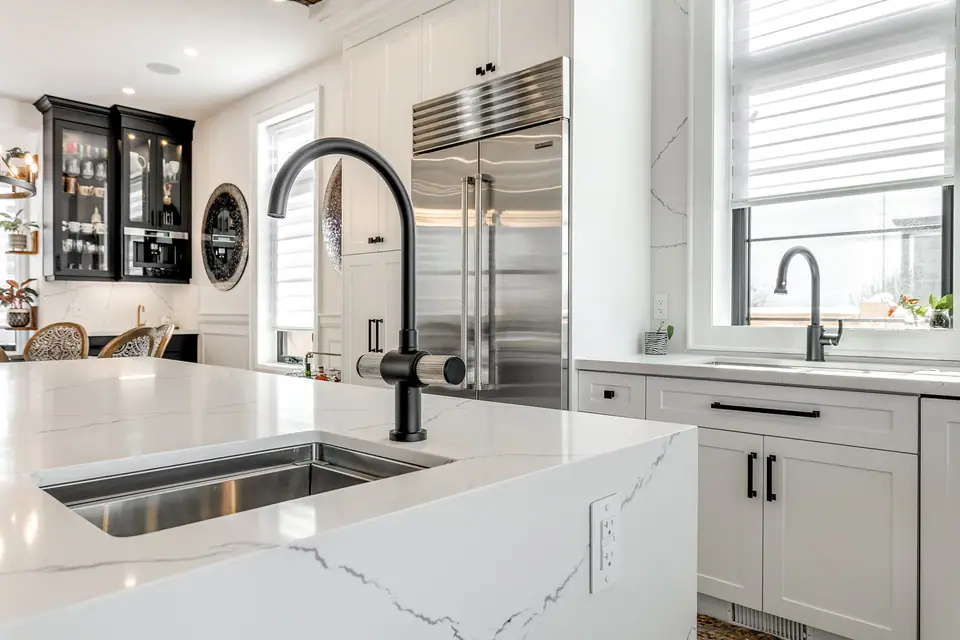
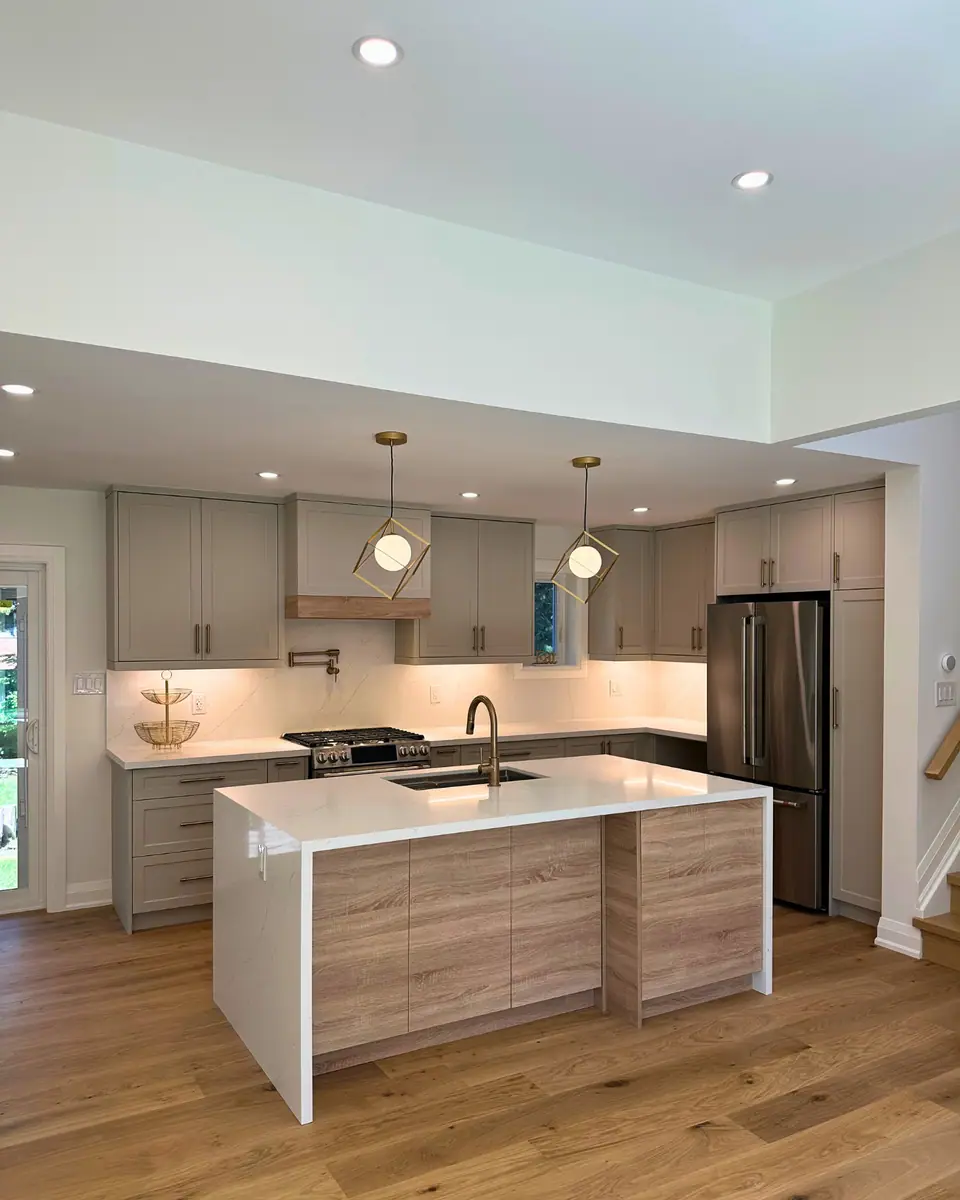
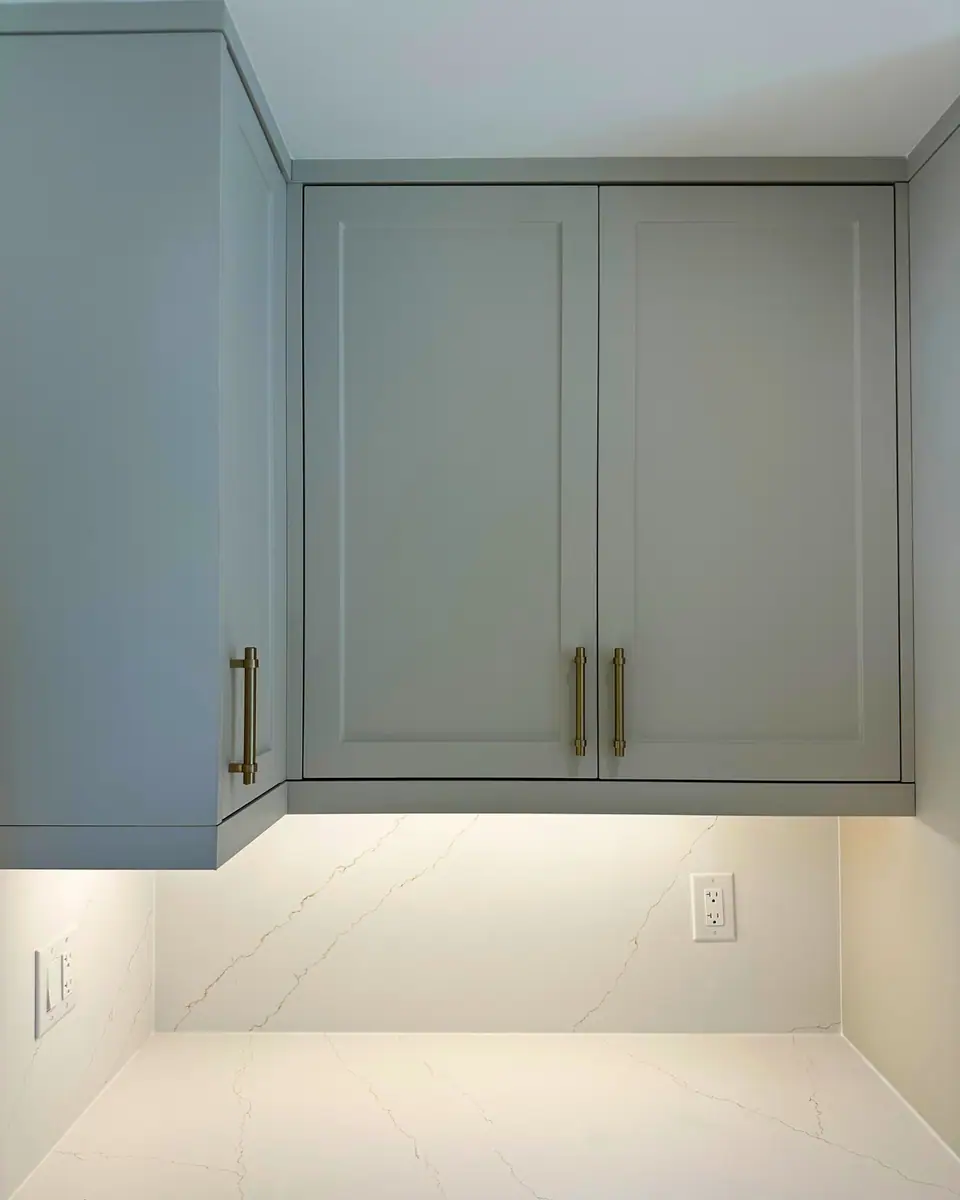
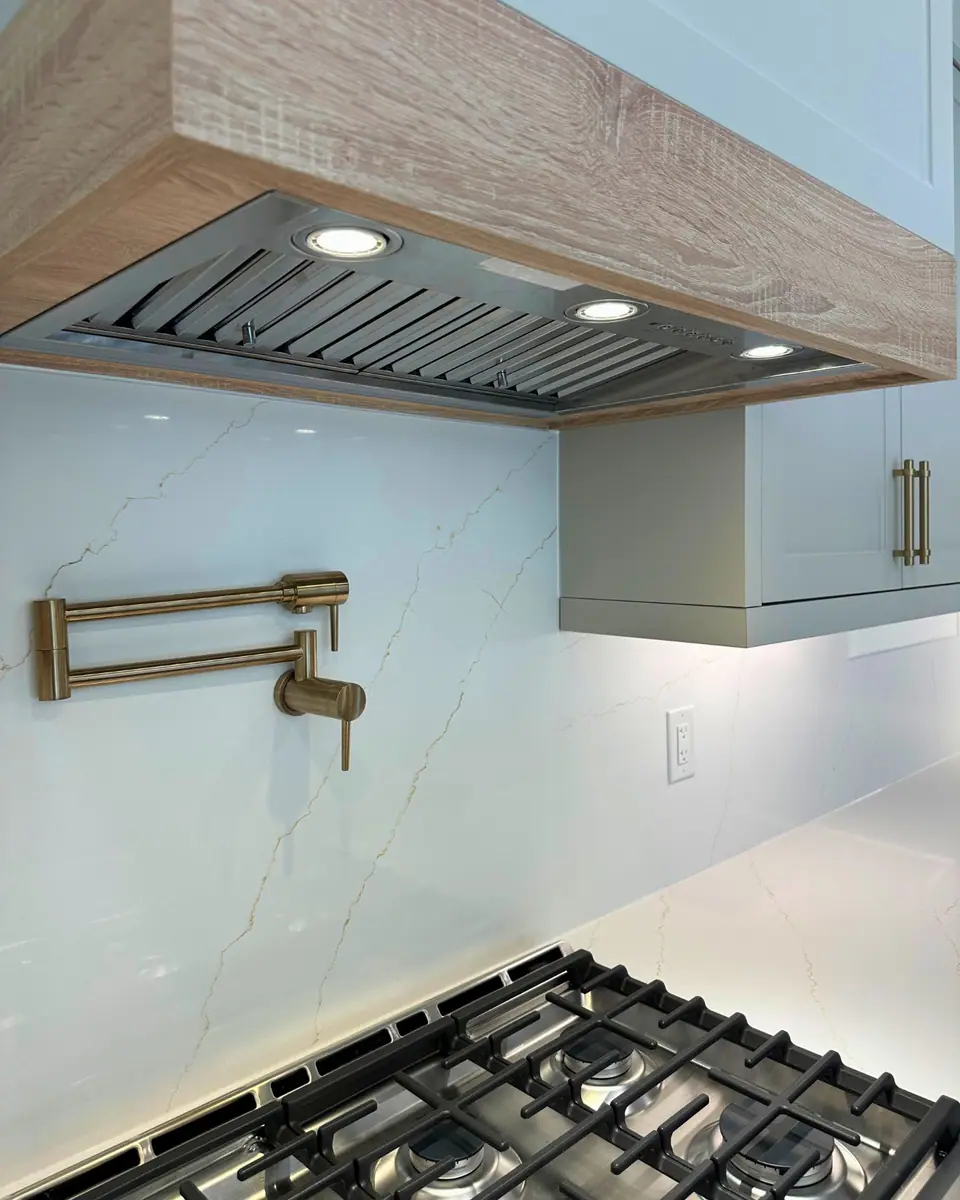
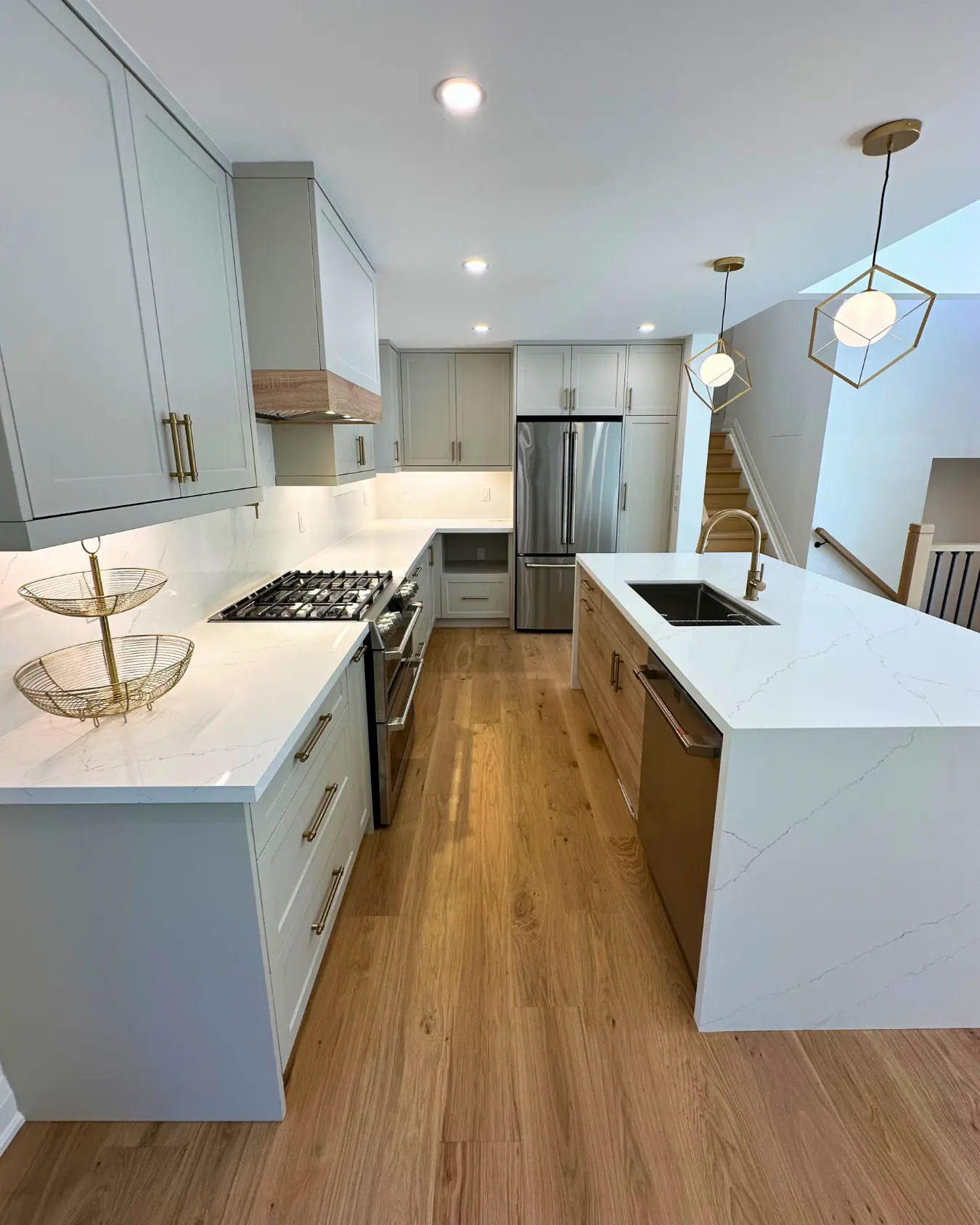
The size of porcelain slabs is their quiet advantage. A 64 by 128 inch slab can top a 10-foot island in one piece, and a thinner slab from the same series can run up the backsplash, so the counter and wall read as one surface. That makes porcelain a strong candidate for a full-height slab backsplash or a waterfall island, where a mitred joint carries the pattern down the side.
Plan the slab layout with the pattern in mind: veining should flow across any seam and from counter to backsplash. Large porcelain also suits bathrooms; two downtown Toronto penthouse bathrooms were finished in large-format porcelain, and slab shower walls use the same idea.
Dust and silica when porcelain is cut
Porcelain is made partly from crushed granite and other rock, so cutting it releases crystalline silica dust. Studies put its silica content well below that of engineered quartz, but not at zero, so the same shop controls apply: wet cutting, local exhaust and respirators where needed. As with any stone top, keep yourself out of the room if an on-site cut is needed. If silica content is part of your choice between materials, see porcelain slab vs quartz countertops.
Questions
Does a porcelain countertop need sealing?
No. Porcelain absorbs so little water, about 0.1 per cent on average for one maker's slabs, that sealers have nothing to soak into. Makers describe their finishes as lasting without sealants or wax.
Can a chipped porcelain edge be repaired?
A chip can be filled and colour-matched, but on a printed slab it exposes the body below the decoration, so the repair blends in rather than disappears. Prevention is the better plan: mitred edges, a 2 mm bevel on exposed edges, and care with cast iron near the edge.
Is 12 mm porcelain thick enough for an island with seating?
It can be, within its overhang limit. One maker allows up to 350 mm of unsupported overhang on 12 mm slabs and 450 mm on 20 mm slabs; a deeper seating overhang needs steel support underneath. Island planning is covered in kitchen countertop thickness and overhangs.
Can porcelain slabs be used for an outdoor kitchen in Toronto?
Many can. Makers describe porcelain as frost resistant thanks to its very low water absorption and suitable for outdoor use, and exterior installation of gauged porcelain panels and slabs has its own standard, ANSI A108.20. Confirm the specific slab is rated for exterior use.
Sources and further reading
- Technical guide for furnishing and design, Laminam 12+ and 20+
- Caring for Your Caesarstone Quartz, Porcelain and ICON Surfaces (Canada)
- Working with compact sintered stone and porcelain slabs, Stone World
- ANSI A137.3, A108.19 and A108.20 specifications for gauged porcelain tiles and tile panels/slabs, TCNA
- Crystalline silica content of porcelain stoneware slabs, Open Ceramics (2024)
Checked November 19, 2026. Codes, by-laws, prices and product specifications change; confirm with your municipality, condo corporation or supplier before you build.
Keep reading
Related guides