Kitchen countertops
Countertop edge profiles
For most kitchens an eased edge is the safe choice: a crisp, nearly square edge with its corners rounded to a small radius, which resists chipping and is usually included in the installed price. Bevels, bullnoses and ogees add shape and cost, and a mitred edge joins a strip under the front at 45 degrees so a thin slab reads as a thick one. Whatever the profile, quartz makers ask for rounded corners, never a sharp square arris.
The common edge profiles at a glance
An edge profile is the shape the fabricator cuts and polishes into every exposed edge of the counter. The names vary a little between shops, but the families are the same. Caesarstone's Canadian technical page lists ten profiles for its quartz (triple laminated bullnose, ogee, double bullnose, full bullnose, eased, double bevel, bevel, double radius, mitre and pencil) and six for its porcelain, a sign that thinner porcelain limits the options.
| Profile | What it looks like | Chip resistance | Cleaning | Typical fit |
|---|---|---|---|---|
| Eased | Square edge with slightly rounded top and bottom corners | Good, better with a larger radius | Easy | Modern, transitional, most quartz |
| Pencil or double radius | Small, even roundover top and bottom | Good | Easy | Soft-modern, family kitchens |
| Bevel or double bevel | A flat 45-degree cut across the top corner (or both) | Good | Easy | Clean lines with a little shadow |
| Half bullnose | Top fully rounded, bottom square | Very good on top | Easy | Traditional and family kitchens |
| Full bullnose | Rounded top and bottom | Very good | Easy | Classic, cottage, kid-friendly |
| Ogee | S-shaped curve with a step | Moderate; the fine step can chip | Crumbs collect in the curve | Traditional, heritage kitchens |
| Mitred (built-up) | A second strip joined under the front at 45 degrees for a thick look | Good if the corner is eased | Easy | Thick-look islands, porcelain, waterfalls |
Why the radius matters more than the profile name
Chips start at sharp corners, where a pot, a dish rack or a stool back meets the stone over a tiny area. That is why Caesarstone Canada's technical guidance tells fabricators to put a radius of at least 3 to 4 mm on any edge profile, calls a 6 mm radius the most durable option, and states that the top and bottom of edges must be rounded, not left square. Its guidance also asks for at least a 6 mm radius on the upper edge of an undermount sink cut-out, the edge that takes the most knocks from pots.
So an eased edge with a generous radius can outlast a more decorative profile with a fine, crisp detail. When you compare quotes, ask what radius the shop puts on its eased edge, and ask to run your hand along a sample. Exposed edges should also be polished or honed to the same finish as the top, so a matte counter does not end in a shiny band.
How the countertop material limits your options
Natural stone has the same colour and pattern all the way through, so any profile shows the stone itself. Quartz is close but not identical: the Caesarstone fabrication guide notes that veins do not always continue through the full depth of a quartz slab, so heavily shaped edges on a veined quartz can show a plainer body under the pattern.
Porcelain is the most restrictive. Builders Ontario notes that many porcelain slabs carry a printed pattern that does not go through the slab, so a chipped edge shows a plain body colour. The same fabrication guide says porcelain works best with simple single-thickness and mitred edges, which is why a mitre that wraps the pattern around the front is the usual way to give porcelain a thicker look.
Thickness changes things too. A 2 cm slab is usually given a laminated or mitred front strip so it reads as 3 cm, and that extra strip is where the mitre line will sit. The countertop thickness and overhangs page covers when 2 cm is enough.
What an upgraded edge adds to the price
In Builders Ontario's October 2026 countertop guide (Central Ontario rates, before HST), eased and pencil edges are included in a standard installed price. Bevels, bullnoses, ogees and the 2-inch mitred thick look are priced as extras at about $12 to $30 per linear foot. Its reference kitchen has about 40 feet of finished edge, so an upgraded profile on every edge adds roughly $480 to $1,200 to that kitchen. GTA quotes vary, and an estimate depends on the kitchen, so use these figures to compare lines on a quote rather than as a price.
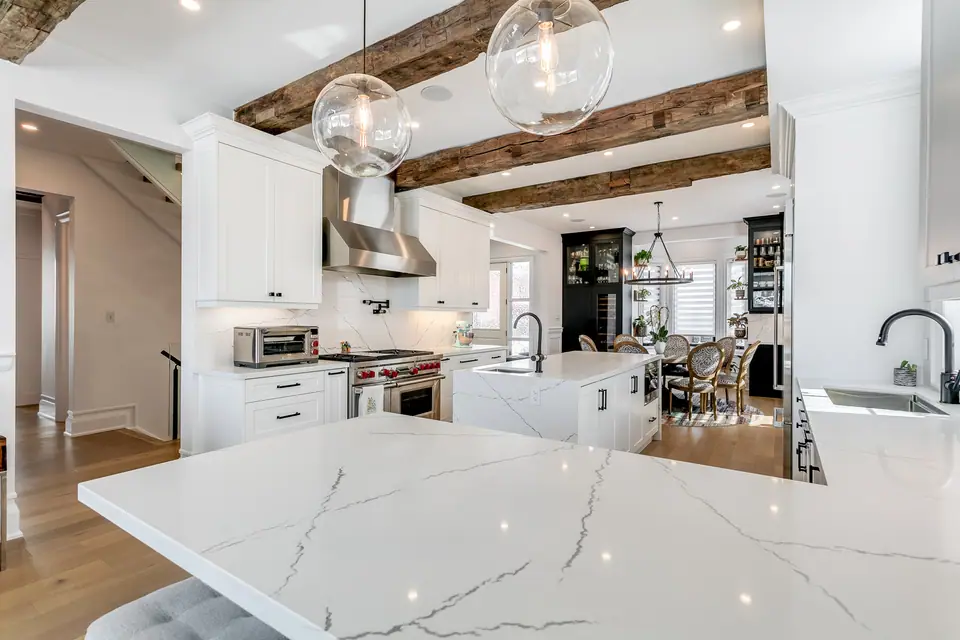
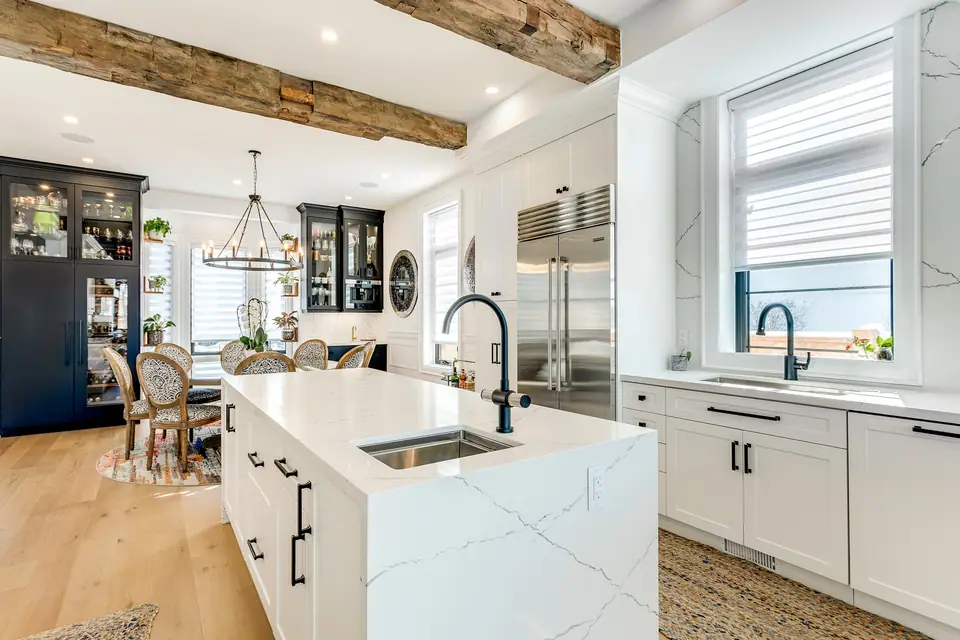
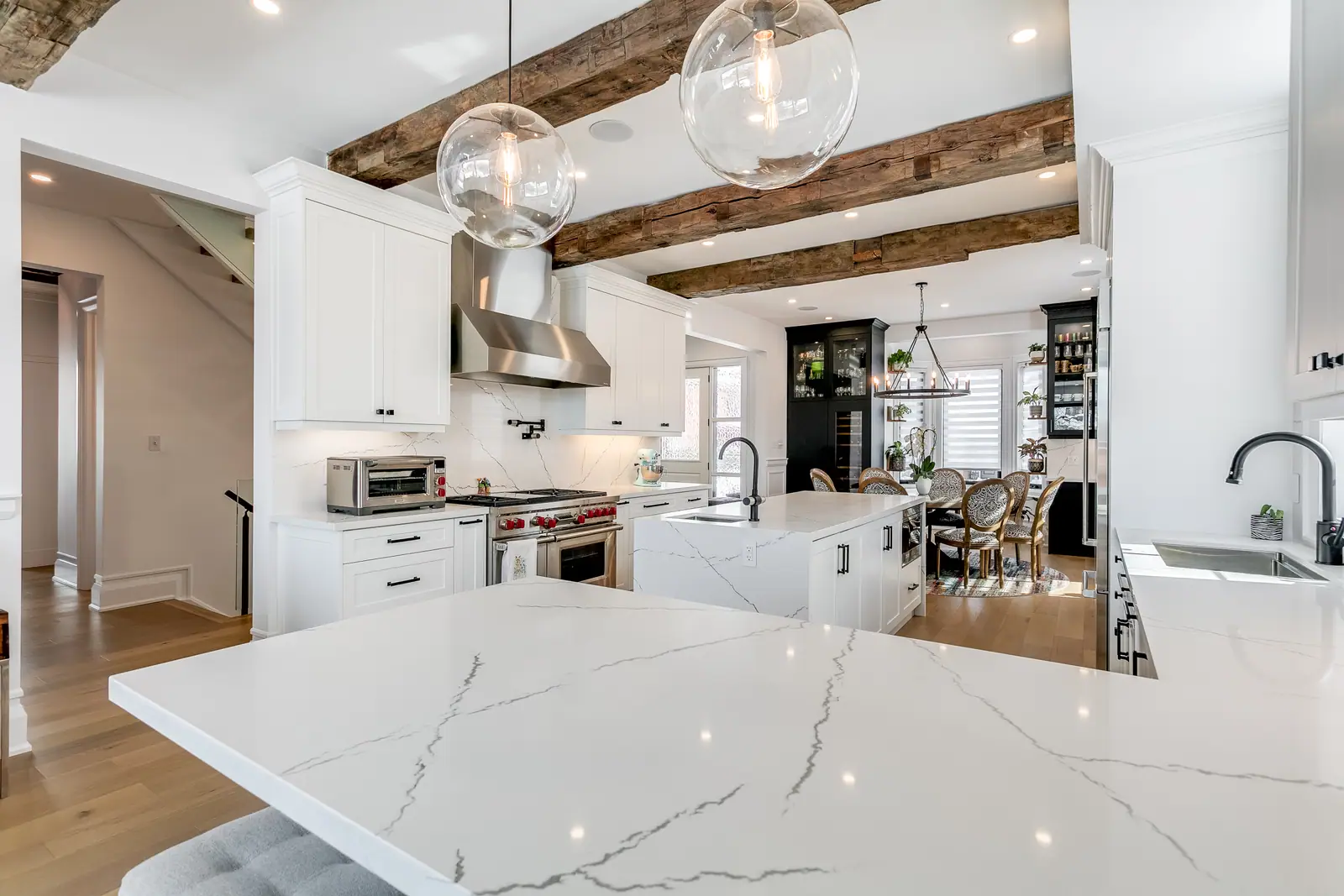
You do not have to use one profile everywhere. A common approach is an eased edge on the perimeter counters and a mitred or thicker edge on the island, where it is seen from the living area. For the full countertop budget, see quartz countertop cost.
| Edge | How it is priced | On a kitchen with about 40 ft of edge |
|---|---|---|
| Eased or pencil | Included in the installed rate | No extra |
| Bevel, bullnose or ogee | About $12 to $30 per linear ft | About $480 to $1,200 |
| Mitred thick look | About $12 to $30 per linear ft | About $480 to $1,200 |
| Waterfall end (for comparison) | About $1,200 per end | Priced per end, not per foot |
Matching the edge to how the kitchen is used
Think about who leans on the counter. At an island with stools, a rounder edge is kinder to forearms and to small children at head height, and a full or half bullnose sheds the occasional bump. In a minimal kitchen with slab doors, an eased edge keeps the lines tight. In a heritage or Victorian kitchen, an ogee can suit the room, but it is the profile most likely to collect crumbs and show a chip in its fine step.
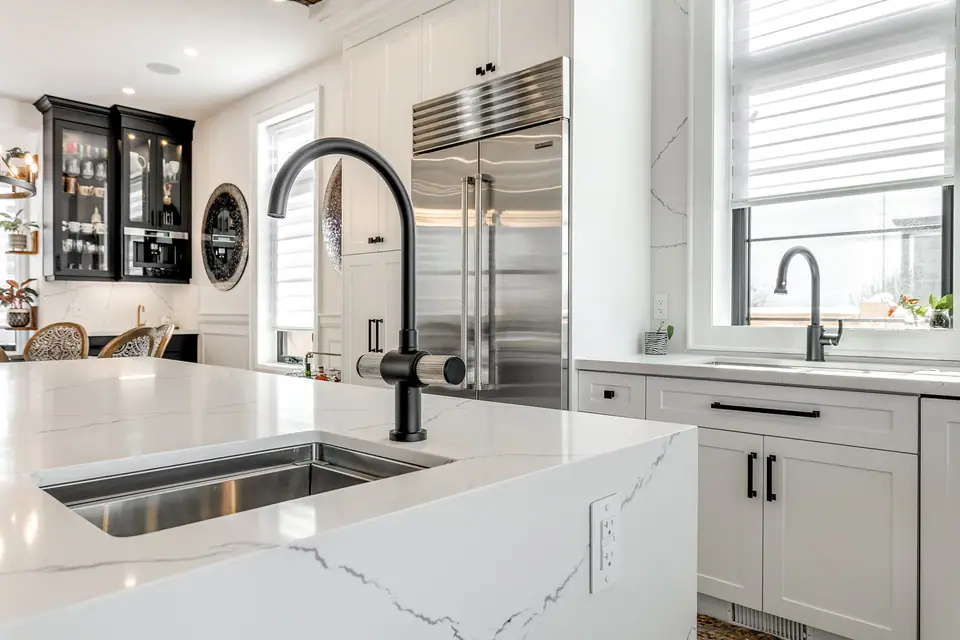
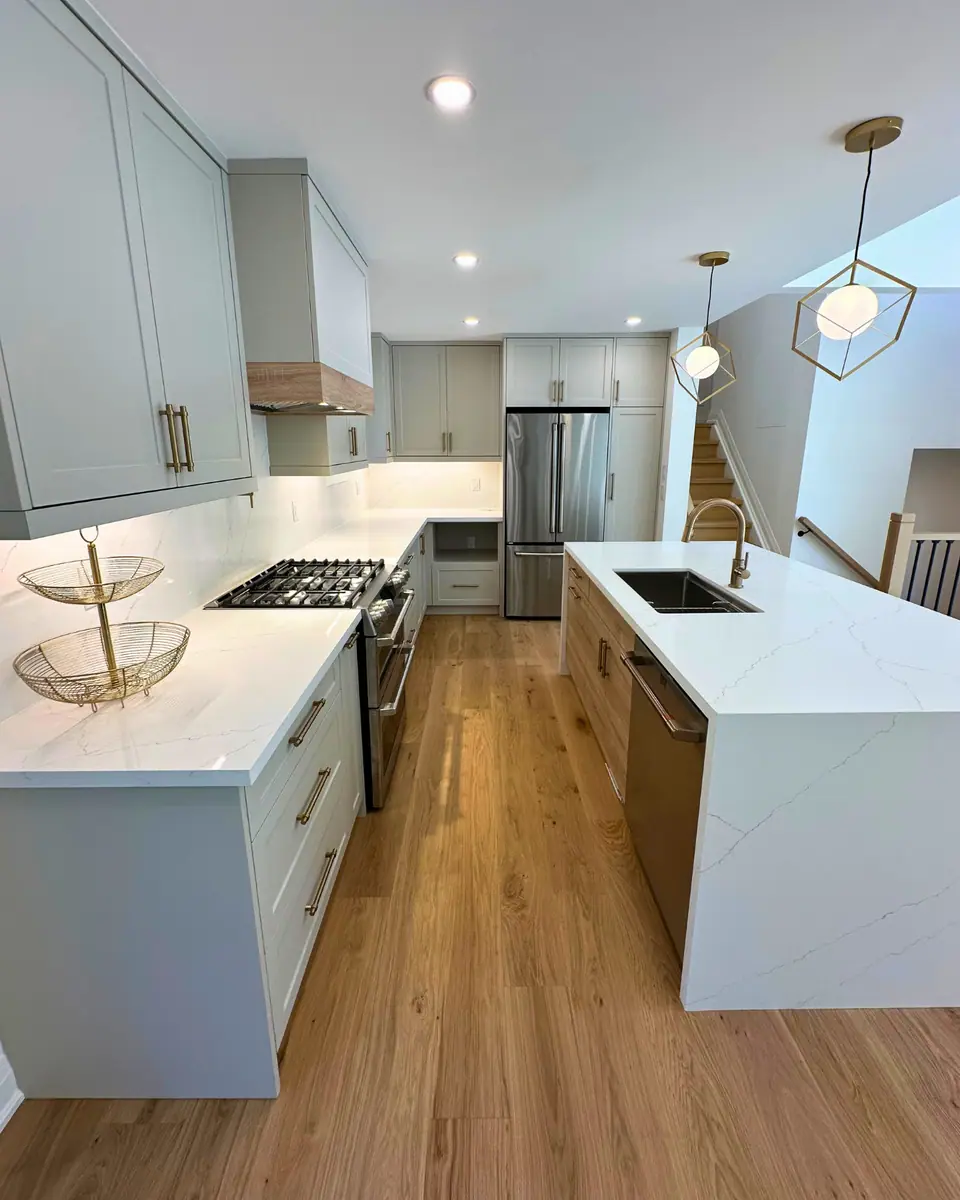
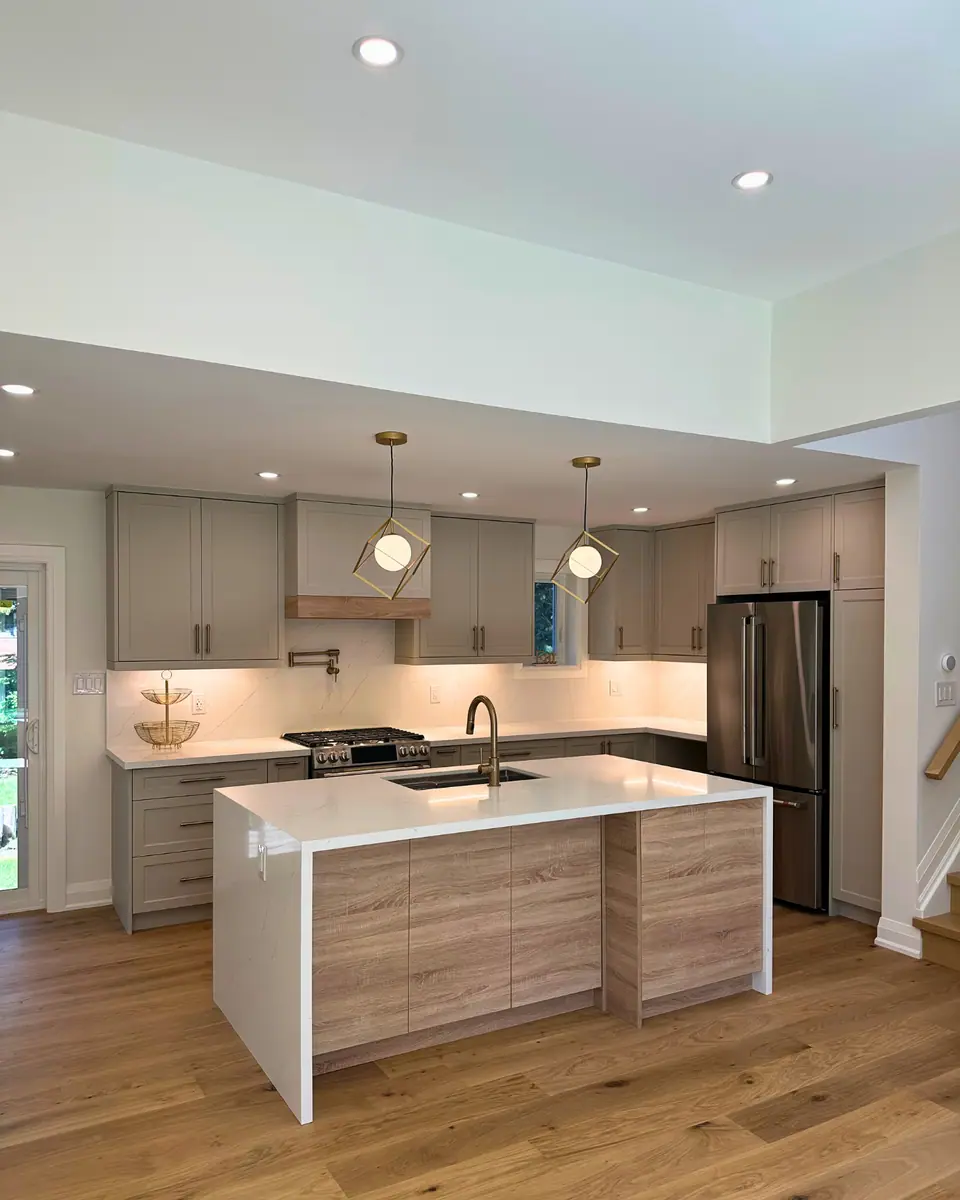
A mitred island edge pairs naturally with a waterfall island, since both rely on the same 45-degree joint. Keep the corner of any mitre slightly eased rather than knife-sharp.
Questions
What is the most chip-resistant countertop edge?
A rounded edge with a generous radius. Caesarstone Canada calls a 6 mm radius the most durable option, so an eased edge with a 6 mm radius, a pencil edge or a bullnose will resist chips better than a sharp square or a finely stepped ogee.
Does a mitred edge leave a visible line?
Yes, there is a fine glue line where the two pieces meet at 45 degrees. On a solid colour it reads as a crisp corner; on a veined slab the fabricator cuts the front strip from the piece next to it so the pattern carries over the edge.
Which edge works with an undermount sink?
The sink cut-out has its own edge, separate from the front profile. It should be polished and rounded; Caesarstone Canada asks for at least a 6 mm radius on the upper edge of an undermount cut-out.
Which countertop edge is easiest to keep clean?
Simple profiles with no grooves: eased, pencil, bevel and bullnose edges wipe clean in one pass. Ogees and other stepped profiles have curves where crumbs and grease settle.
Sources and further reading
- Caesarstone Canada: Products technical information (edge profiles and minimum radius)
- Caesarstone: Countertop fabrication guide
- Builders Ontario: Countertop cost in Ontario (2026)
Checked November 19, 2026. Codes, by-laws, prices and product specifications change; confirm with your municipality, condo corporation or supplier before you build.
Keep reading
Related guides