Surface comparison
Porcelain slab vs quartz countertops
Porcelain slabs are large, thin sheets of fired ceramic, usually 12 mm or 20 mm thick for counters, that accept hot cookware and resist sunlight. Quartz is a thicker engineered slab bound with resin: it needs a trivet but has colour through its body and sturdier edges. Go with porcelain for heat, UV and a matching wall-to-counter look; stay with quartz for profiled edges, simpler fabrication and fewer chips at the edge.
What separates a porcelain slab from a quartz slab
Porcelain and quartz look alike in a showroom, but they are made in opposite ways. A porcelain slab is pressed from clay and minerals, decorated, then fired in a kiln into a very dense ceramic panel. In North America these products fall under ANSI A137.3, the Tile Council of North America standard for gauged porcelain tiles and tile panels or slabs, which covers panels of one square metre or more. The Porcelain Tile Certification Agency only certifies a body as porcelain if it absorbs 0.5% water or less when tested to ASTM C373.
Quartz is made from about 90% crushed quartz bound with resins and pigments, then pressed and cured. The resin is what gives quartz its toughness at the edge and also what limits it around heat and sunlight. Nearly every difference below traces back to fired ceramic versus resin-bound stone.
How they perform in an actual kitchen
Comparing spec sheets only goes so far. The table works through situations every kitchen meets and says which surface handles each one better.
| In your kitchen | Porcelain slab | Quartz | Better choice |
|---|---|---|---|
| A pot straight off the burner | Can go directly on the surface | Use a trivet to prevent burning | Porcelain |
| A slow cooker or warming tray for hours | Use an insulated mat under it | Use a trivet | Even |
| Counter under a sunny window or outdoors | UV- and weather-resistant | Standard resin can change colour in UV | Porcelain |
| A cast-iron pan knocked against the edge | Mitred edges are brittle and can chip | Solid edge with no mitre joint | Quartz |
| A rounded or bevelled edge profile | Limited on 12 mm, where the pattern sits on the surface | Colour runs through, so most profiles work | Quartz |
| Same surface on the backsplash, walls or floor | Available in 6 mm sheets for walls and floors | Slab backsplash only | Porcelain |
| Weight on cabinets or an old floor | Lighter than stone | Heavier, like natural stone | Porcelain |
| Fabrication | Harder and denser: slower to cut | Familiar stone-shop process | Quartz |
Thickness: 6 mm, 12 mm and 20 mm do different jobs
With porcelain, the thickness you choose decides how the counter is built and how it looks at the edge. Daltile's guidance on porcelain slabs breaks it down: 6 mm is strong yet light, made for wall cladding and floors; 12 mm is the most versatile, used on walls, floors and counters; and 2 cm (20 mm) is the premium counter choice, with through-body veining so a cut edge looks like real stone.
On 12 mm slabs the veining does not run through the body, so the edge has to be mitred: a second strip is cut at 45 degrees and bonded under the front so the pattern wraps around and the counter looks thicker. Some makers back their thicker counter slabs with a bonded fibreglass mesh for reinforcement.
Quartz is usually sold in thicker slabs with colour throughout, so an eased, bevelled or rounded edge can simply be ground into the slab. That is the core trade: porcelain asks for more careful edge design, quartz forgives it.
Edges are where porcelain needs the most care
Chipping at the edge is the most common complaint about porcelain counters, and it is avoidable with the right details. Fine Homebuilding notes that mitred porcelain edges are relatively brittle and can chip when cookware is dropped on them, and that a squared edge is less prone to chipping than a mitred joint. Arizona Tile's porcelain slab FAQ recommends that every edge get a micro-bevel or a 1 mm round to soften it.
In practice, that means asking three questions before you order: will the slab be 12 mm with a mitre or 20 mm with a solid edge, how will the fabricator soften the sharp top edge, and how much experience does the shop have with porcelain, which Construction Canada notes can take longer to fabricate because it is harder and denser. A family kitchen where heavy pans meet the island edge daily may be better served by a 20 mm porcelain slab or by quartz.
Heat, sunlight and stains: porcelain's strongest ground
On heat, the clearest evidence comes from a company that sells both. Caesarstone's Canadian care manual says cookware can go directly on its porcelain straight from the oven or cooktop, with only appliances that give off constant heat for long periods needing an insulated mat. For its quartz surfaces it recommends a trivet to prevent the material burning.
Sunlight follows the same pattern. Daltile describes porcelain slabs as UV- and weather-resistant, suited to outdoor kitchens, while Construction Canada notes that quartz is not recommended outside because its colours can fade with prolonged UV exposure.
For stains, both are low-maintenance. Porcelain is dense enough to resist stains with no sealer; quartz is non-porous, though stains can form from chemical reactions with its resin, and penetrating sealers are not recommended on it. One shared caveat: Caesarstone notes that honed, natural and textured finishes show metal marks and fingerprints more than polished ones, on porcelain and quartz alike.
Where each surface fits in a GTA home
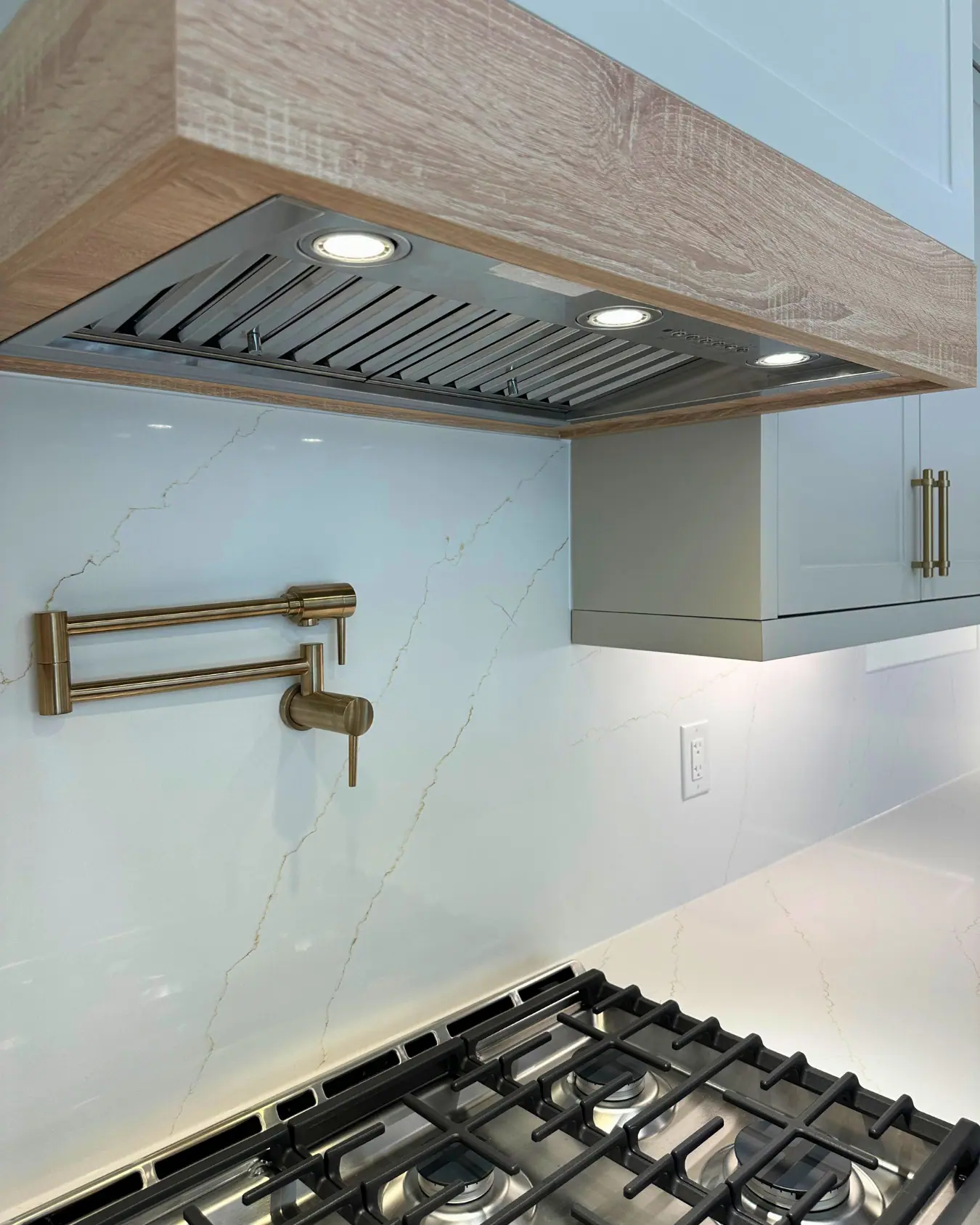
Porcelain earns its place where one material should run across several surfaces. A 12 mm counter can continue up the wall as a full-height slab backsplash, and the same product family in 6 mm can clad shower walls, as in the large-format porcelain used in the penthouse bathroom renovation in downtown Toronto. It also suits condo kitchens facing floor-to-ceiling glass, sunrooms and backyard kitchens.
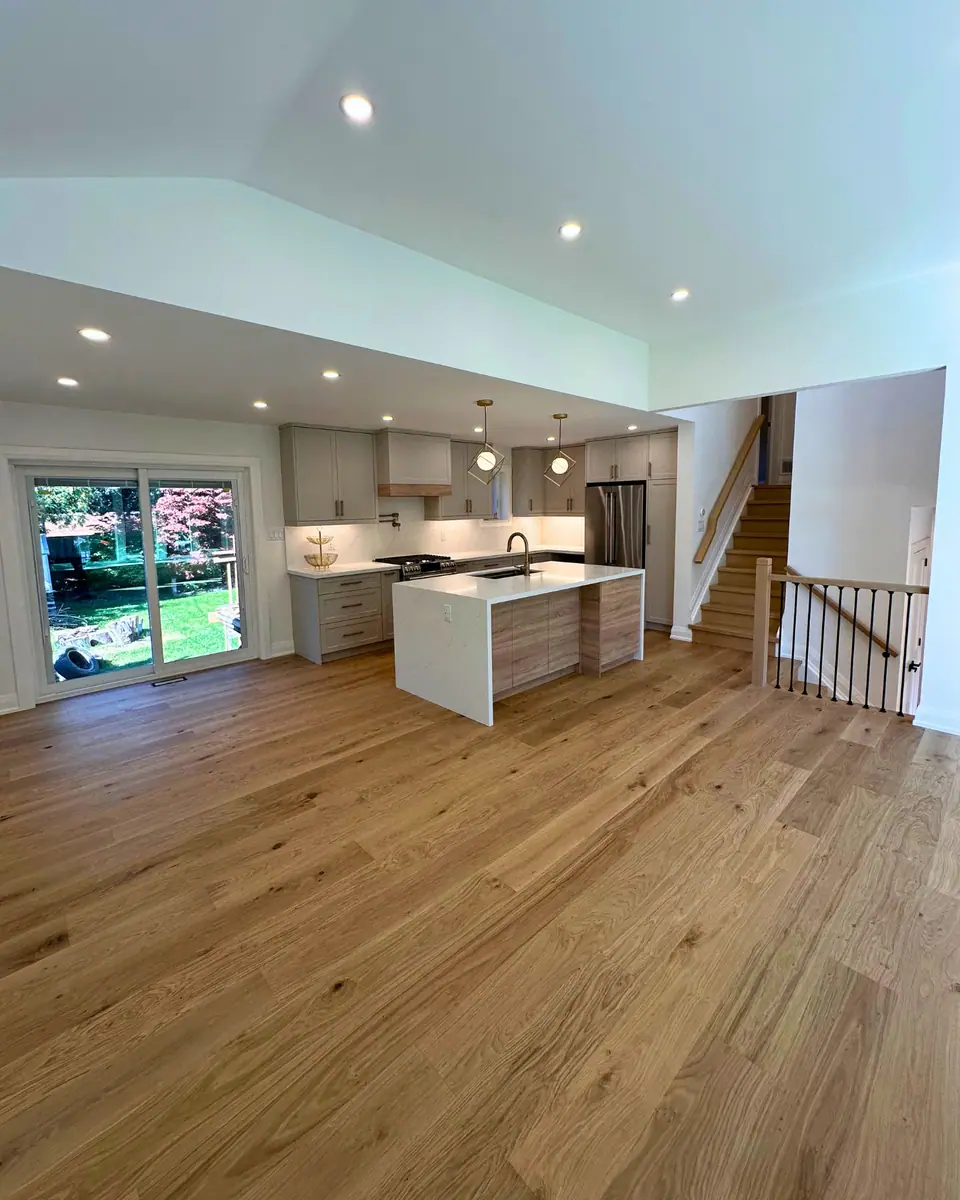
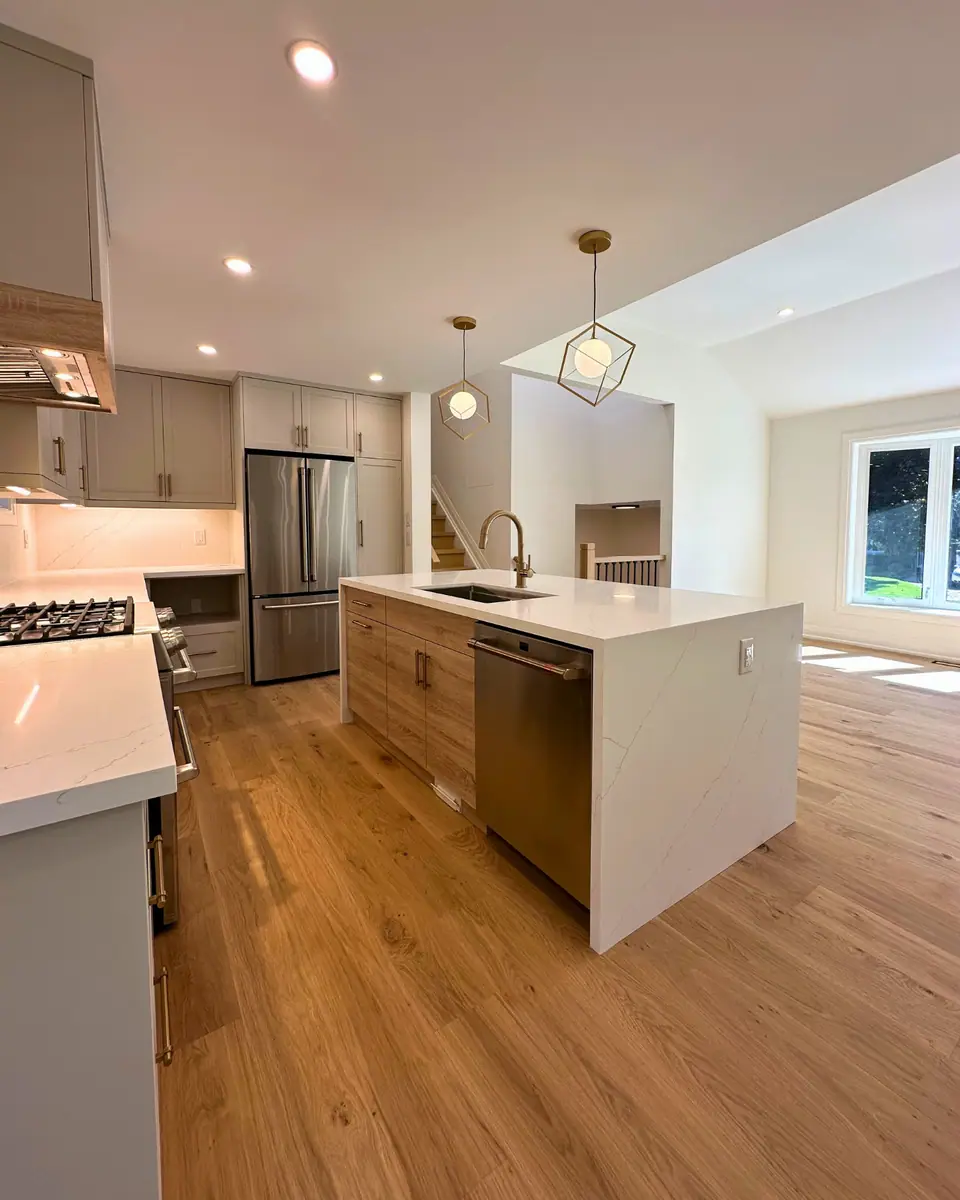
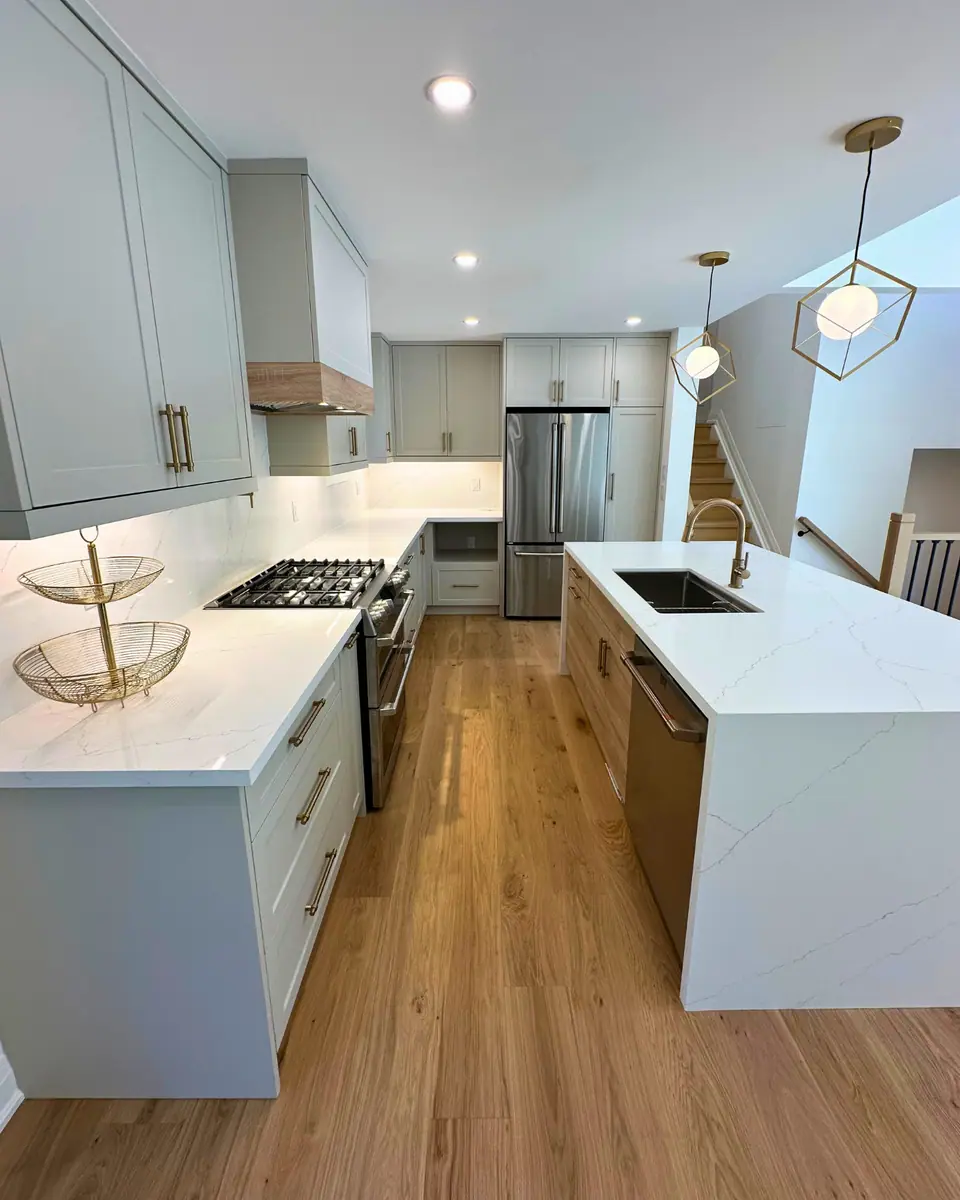
Quartz remains the safer default for a hard-working family island with seating and a profiled edge, and for long runs where a predictable, repeatable pattern matters. The Victorian kitchen renovation in Milton pairs a quartz waterfall island with a full-height quartz backsplash behind a professional range. Material depth for each is on porcelain slab countertops and quartz countertops for kitchens.
So which one: porcelain or quartz?
Decide by the conditions the counter will face, then by the edge you want.
- Go with porcelain if you put hot pans down without thinking, the counter gets strong sun or sits outdoors, you want the counter, backsplash and walls in one material, or you want a thin, light modern profile.
- Stay with quartz if the edge takes heavy daily knocks, you want a rounded or bevelled profile, you prefer a slab most fabricators know well, and you are content to use trivets.
- Either way, cut on a board: Caesarstone allows cutting directly on its porcelain but still recommends a chopping board for daily use.
Questions
Does a porcelain countertop need sealing?
No. Porcelain is fired to a very dense body that absorbs almost no water, so it resists stains without a sealer or wax. Clean it with warm soapy water, and use a non-abrasive cream cleaner on metal marks, which show more on matte finishes.
Can porcelain slab be used for an outdoor kitchen in Ontario?
Porcelain slabs are sold as UV- and weather-resistant, which makes them one of the better outdoor counter options. Confirm with the maker that the specific slab, the adhesive and the support are rated for exterior use and freeze-thaw cycles before committing.
Is 12 mm porcelain thick enough for a kitchen counter?
Yes, it is widely used on counters, but its edge is normally mitred to look thicker because the pattern does not run through the body. If you want a solid edge with through-body veining, ask for a 20 mm slab instead.
Why does a porcelain counter show grey marks?
Those are usually metal marks left by pots, rings or utensils on a honed or textured finish. They sit on the surface rather than in it and normally come off with a non-abrasive cream cleaner. A polished finish shows them less.
Sources and further reading
- Daltile: Porcelain slabs, where, when and why to use them
- Caesarstone Canada: Caring for quartz, porcelain and ICON surfaces
- Construction Canada: New kid on the (chopping) block, designing with porcelain slabs
- TCNA: ANSI A137.3, A108.19 and A108.20 gauged porcelain tile panels and slabs
- Arizona Tile: Della Terra porcelain slabs FAQs
Checked November 19, 2026. Codes, by-laws, prices and product specifications change; confirm with your municipality, condo corporation or supplier before you build.
Keep reading
Related guides