Kitchen countertops
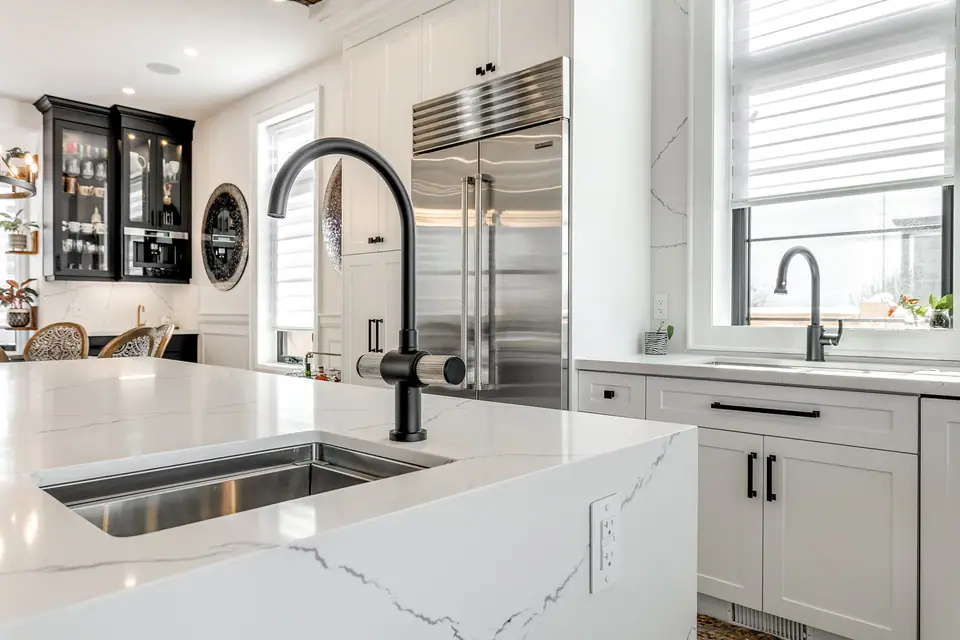
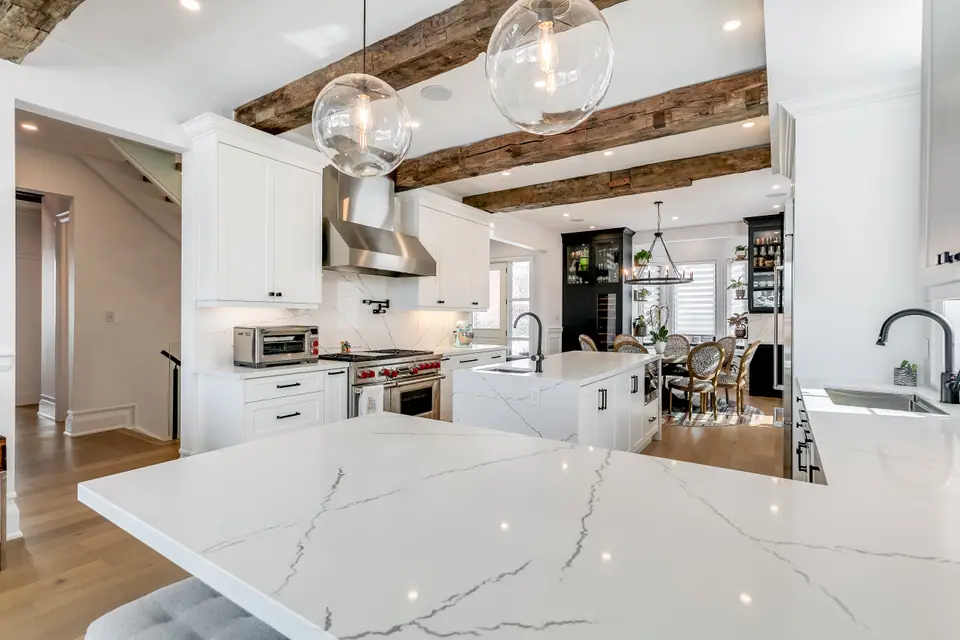
Marble countertops in a working kitchen
Marble works in a working kitchen if you accept that it will change. Acids such as lemon, tomato, vinegar and wine etch dull marks into calcite marble, and no sealer prevents that; sealing only slows stains from oil and coloured liquids. A honed finish hides etching far better than a polished one, dolomitic marbles etch a little more slowly, and the marks can be buffed out or left to become a patina.
Etching, staining and scratching are three different problems
Marble is a metamorphic rock made of carbonate minerals, mostly calcite or dolomite, and acids react with that calcium carbonate. The result is an etch: a dull or lighter patch, most visible when you look across the counter toward a window. The Natural Stone Institute describes it as a dull spot or burn mark, and notes that it does not weaken the stone or shorten its life. It is a change in the surface, not damage to the slab.
A stain is something else. It happens when a liquid soaks into the stone's pores and leaves colour behind, with red wine and oil the usual culprits. Wiping red wine up quickly usually prevents a stain, but its acid can still leave an etch. Scratches are the third issue: marble is soft, so knives, cast iron and grit dragged under a mixing bowl will mark it.
| Mark | Cause | What it looks like | Does sealer help? | How it is fixed |
|---|---|---|---|---|
| Etch | Acid: citrus, tomato, vinegar, wine, acidic cleaners | Dull or pale patch, seen at an angle | No | Marble polishing powder or etch remover for light marks; professional honing for many |
| Stain | Oil, wine, coffee and other liquids soaking in | Darker or coloured spot | Yes, it slows absorption | A poultice draws it out; restorers can pull deeper stains |
| Scratch | Knives, cookware, grit | Fine lines in the surface | No | Cutting boards prevent it; refinishing removes it |
Honed marble hides etching; polished marble shows it
On a polished slab, every etch breaks the gloss and catches the light. On a honed (matte) or textured slab, the same etch blends into a surface that is already low-sheen, so it is far harder to spot. The Natural Stone Institute's guidance is direct: honed or textured marble is the more practical kitchen finish.
Finish also sets the maintenance rhythm. A stone restorer quoted by the Institute suggests refinishing polished marble every 2 to 3 years and honed marble every 3 to 5 years. Refinishing removes a very thin layer of stone, and marble can be refinished many times over its life, so a counter that looks tired after a decade can be brought back rather than replaced.
If you love the mirror shine of polished marble, consider it for a bar, a baking counter or a bathroom vanity, and choose honed for the counter where food is prepped every day.
Which marbles suit a kitchen, and what is sold as marble
Most white kitchen marbles are calcite marbles, including the Carrara family from Tuscany: Bianco Carrara with its white to blue-grey ground, and the Calacatta varieties, which are among the more expensive. All of them etch on contact with acid.
Dolomitic marbles are made mostly of dolomite rather than calcite. The Natural Stone Institute describes dolomite as slightly harder and slower to etch, but it calls the difference subtle. Super White is the best-known example: it is often sold as quartzite, yet the Institute's testing identified it as a brecciated dolomitic marble, which did not scratch glass and fizzed only when acid touched its powder.
Labels in a slab yard are not always reliable, so test a sample before you buy. The quartzite countertops page walks through the glass scratch and lemon tests, and quartz vs quartzite covers the two materials people most often compare with marble.
| Stone | Main mineral | Etches with acid? | Note |
|---|---|---|---|
| Calcite marble (Bianco Carrara, Calacatta) | Calcite | Yes, quickly | The classic white kitchen marbles |
| Dolomitic marble (Super White and others) | Dolomite | Yes, more slowly | Often mislabelled as quartzite |
| True quartzite | Quartz | No | Hard; still needs sealing |
| Engineered quartz | Quartz in resin | No | No sealing; resin is heat-sensitive |
Sealing: a stain shield, not an etch shield
A true penetrating sealer works below the surface so liquids cannot soak in. It does nothing to stop etching, however many coats are applied. Topical coatings that sit on the surface can reduce both etching and staining, though the marble can still scratch.
How often to reseal depends on the product. Labels range from about 6 months to more than 10 years, and the Natural Stone Institute's position statement expects a quality sealer to last 10 to 15 years. The simple check is a water test: put a few drops on the counter and wait. If the stone darkens under them, it is absorbing and is due for sealing.
The Institute's own writer lived with honed Imperial Danby marble for a year after sealing it at installation. A coffee ring left for 12 hours, a marinara spill and a burst bottle of berry kombucha left no stains. The one discolouration was yellowing at the sink seam where water pooled, and a baking soda or hydrogen peroxide poultice reversed it.
Planning a marble kitchen around where the work happens
In that same year-long test, most etches collected in the prep zone. That points to the decisions worth making at the design stage rather than after install day.
If you want a perfectly uniform surface for decades, marble is the wrong stone, and quartz countertops for kitchens is the page to read. If you want a surface that records use, plan for it and enjoy it.
- Split the materials. Marble on the island or a baking station, a harder surface on the sink and prep run where lemons and tomatoes get cut.
- Choose honed for any marble that sits in the prep zone.
- Give the knife work a home. The Institute suggests boards about 20 by 20 inches, one by the sink and one by the stove.
- Clean with mild soap or a stone cleaner. Avoid vinegar, lemon and other acidic cleaners, and do not squeeze citrus directly over the stone.
- Keep water from pooling at the sink. A well-sealed sink seam and a quick wipe prevent the yellowing that shows up there first.
What marble costs to install in Ontario
Marble sits near the top of the countertop price range. Builders Ontario's October 2026 cost guide, based on Simcoe County and Central Ontario rates, prices installed 3 cm marble at about $125 a square foot with a plain edge, delivery and installation, before HST. Its 59 sq ft reference kitchen comes to about $7,400 in marble, against about $6,200 for mid-tier quartz. GTA quotes vary with the slab, the layout and access, so treat these as a reference point, not a price.
Veined marble also uses more stone at seams, because the fabricator lays the pieces out so the veining runs across the joint. Ask for the slab layout before cutting, and pick the actual slabs in person.
| Item | Typical figure | Note |
|---|---|---|
| Marble, installed, 3 cm | About $125 per sq ft | Plain edge, one sink cut-out included |
| Mid-tier quartz, installed | About $105 per sq ft | For comparison |
| Extra sink cut-out | About $150 | Farmhouse cut-outs cost more |
| Faucet holes | About $75 | Drilled in the shop or on site |
| Removing the old top | About $500 | Varies with material and access |
Questions
Can etch marks on marble be removed at home?
Light etches often can. Marble polishing powder or an etch remover rubbed into the dull spot for a few minutes usually brings the sheen back on a small mark. Widespread etching across a prep area is a job for a stone restorer, who hones and refinishes the whole surface.
Will red wine stain a sealed marble counter?
A good penetrating sealer gives you time to wipe the spill before it soaks in, so a prompt wipe usually prevents a stain. The acid in the wine can still etch the surface, because sealers do not stop etching.
Is Super White marble or quartzite?
Testing reported by the Natural Stone Institute found Super White to be a brecciated dolomitic marble. It did not scratch glass, which rules out quartzite, and it etches, though more slowly than a calcite marble such as Carrara.
What should I clean marble countertops with every day?
Warm water with a little dish soap, or a cleaner labelled safe for natural stone. Skip vinegar, lemon-based sprays and any cleaner with acid in it, since those etch the surface you are trying to clean.
Sources and further reading
- Natural Stone Institute (Use Natural Stone): How to care for your marble countertops
- Natural Stone Institute (Use Natural Stone): A year with marble countertops in the kitchen
- Natural Stone Institute (Use Natural Stone): Coming full circle with Super White
- Natural Stone Institute: Sealing stone, consumer position statement
- Builders Ontario: Countertop cost in Ontario (2026)
Checked November 19, 2026. Codes, by-laws, prices and product specifications change; confirm with your municipality, condo corporation or supplier before you build.
Keep reading
Related guides