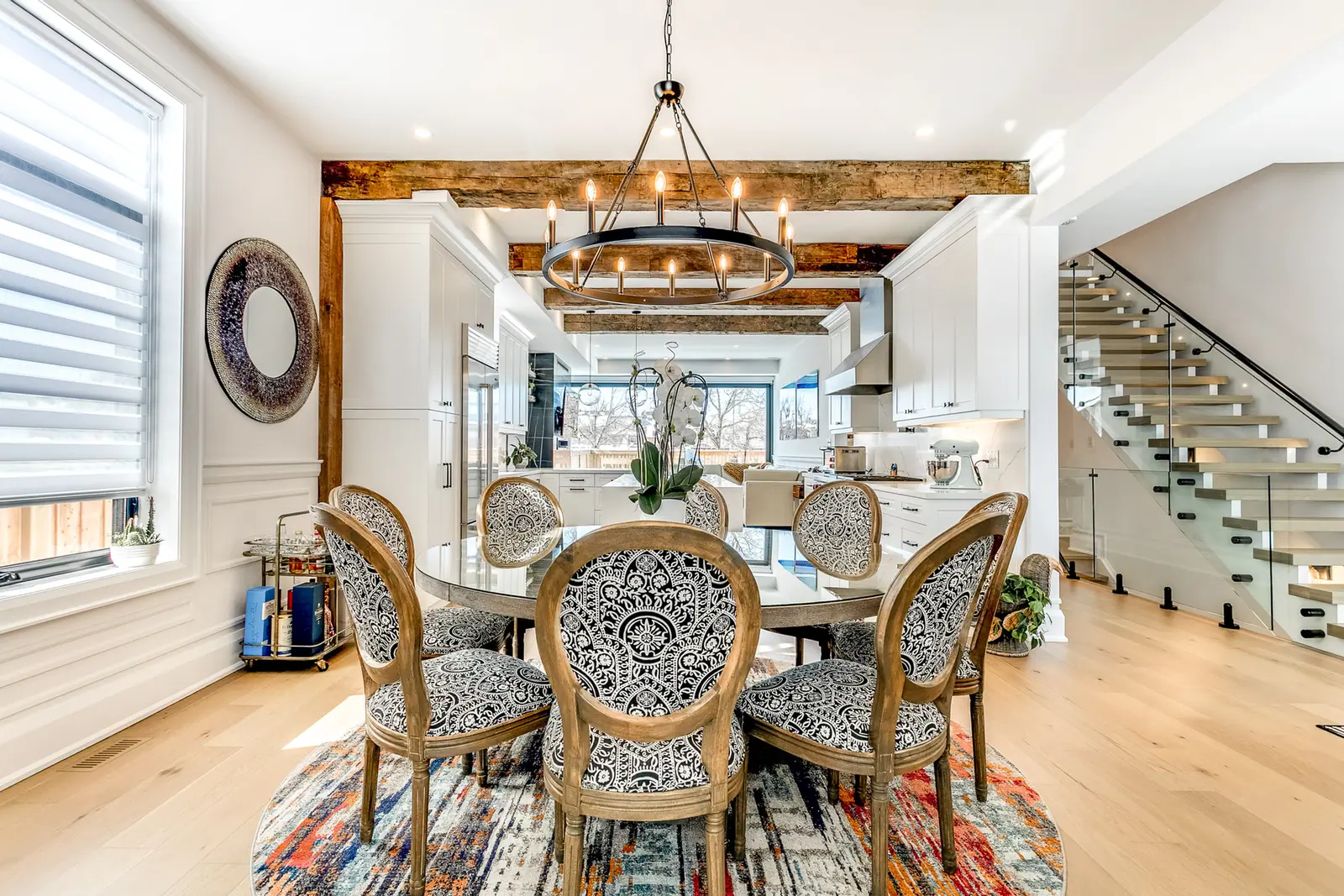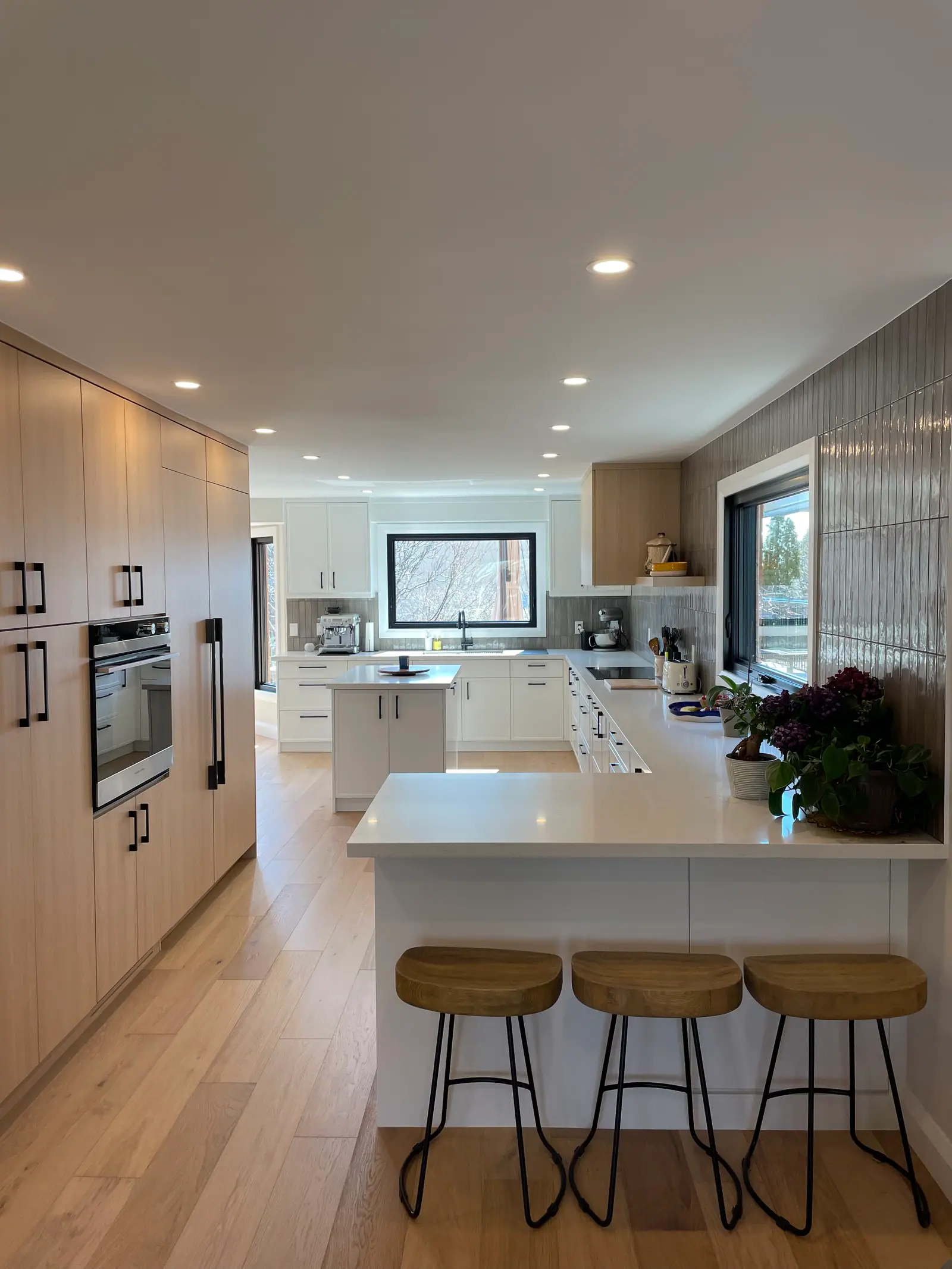
Cabinet finishes
Painted kitchen cabinets
Painted kitchen cabinets last best when the paint is a factory-sprayed, catalysed finish over a stable base such as MDF. Two honest trade-offs come with paint: it shows chips at busy edges more readily than a clear wood finish, and on five-piece wood doors a fine line can open where the frame joints meet as the wood moves through the seasons. Brushing or spraying paint onto existing cabinets costs less but wears faster. Clean with mild soap and water, and keep the colour code for touch-ups.
Factory-sprayed paint and paint applied in your kitchen are different finishes
The word painted covers two very different results. New painted cabinets are usually sprayed and cured in a finishing room before they reach the house. Painting existing cabinets happens in the kitchen, over old finish, after cleaning, sanding and priming. Fine Homebuilding's cabinet guide notes that catalysed finishes are extremely durable and now the norm for factory cabinetry, and that painted surfaces are somewhat less durable than clear finishes, so the method matters more with paint than with stain.
| Question | Factory-sprayed finish | Repainting existing cabinets |
|---|---|---|
| Where it is applied | Spray booth, before installation | In the kitchen or a temporary site shop |
| Typical coating | Catalysed coatings, sprayed and cured under controlled conditions | Architectural enamels and primers |
| Surface prep | New, consistent substrate | Degreasing and sanding an old finish; adhesion depends on it |
| Cure | Cured in the shop before delivery | Follow the paint maker's data sheet before heavy use |
| Best for | New kitchens and replacement doors | Sound boxes and a layout you want to keep |
Why MDF is the usual base for painted doors
MDF has no grain, so it stays flat, takes paint smoothly and can be machined into crisp profiles. A painted slab door in MDF has no joints at all, which makes it the most stable painted door you can buy.
Five-piece doors are different. In a solid-wood shaker door, the centre panel floats in its frame so the wood can expand and shrink without splitting. Painted, that floating panel can shrink in dry winter air and reveal a sliver of unpainted edge where it meets the frame. An MDF centre panel barely moves, so most painted shaker doors pair a hardwood or MDF frame with an MDF panel. The structure of each style is covered in kitchen cabinet door styles.
MDF has one limit you should know: it does not like standing water. Paint protects the faces, but chips and worn edges let moisture in, and unsealed MDF can swell. Keep an eye on the doors beside the dishwasher and under the sink.
Hairline lines at frame joints: what they mean
A thin line in the paint where a rail meets a stile on a five-piece door is normal wood movement, not a failed door. The rail's grain runs across the stile's grain; as humidity changes, the rail grows and shrinks in width while the stile barely changes in length, and a rigid paint film over that joint can crack along it. Fine Homebuilding notes that painted surfaces may show joinery gaps more readily than clear finishes.
In a GTA house the swing is seasonal: heated air in winter is dry, summer air is humid. Keeping indoor humidity steadier with a humidifier in winter reduces movement, and an MDF frame or a slab door avoids the joint line entirely. If perfectly unbroken paint matters to you, choose slab MDF or ask whether the shaker frames are MDF.
How tough a factory paint finish should be
Ask whether the cabinet line is certified to ANSI/KCMA A161.1, the North American performance standard for kitchen and vanity cabinets. Its finish tests are a useful checklist even when a line is not certified, because they mirror what a kitchen actually does to paint.
| Test | What is done | What must not happen |
|---|---|---|
| Hot and cold check | Five cycles: one hour at 49°C and 70% humidity, then a cold box at minus 21°C | Cracking or checking of the finish |
| Household stains | Lemon, orange and grape juice, ketchup, coffee, vinegar, olive oil, 100-proof alcohol and detergent left 24 hours; mustard 1 hour | Stains or whitening that ordinary polishing will not remove |
| Detergent edge soak | Door edge on a sponge of dish-detergent solution: 24 hours for solid wood or painted doors, 4 hours for edgebanded or thermofoil doors | Swelling, delamination, blistering or whitening |
Chips, touch-ups and everyday cleaning
Paint chips where hands, hips and pots hit: the edges of drawer fronts beside the range, the door nearest the dishwasher, the toe-kick and the corners under pulls. Hardware placement helps, because a pull that is easy to grip means fewer fingers on the paint.
Small chips are touched up with the original colour, so ask for the exact colour and sheen code and a small touch-up kit at installation. Very hard catalysed finishes protect well but are harder to blend invisibly than softer coatings; Fine Homebuilding notes that some people prefer lacquer because it is more repairable. A badly damaged door is usually refinished or replaced rather than patched.
For cleaning, a soft cloth and water with a little dish soap is enough. Skip abrasive pads and powder cleansers, which dull the sheen, and wipe up water at the bottom edges of doors rather than letting it sit.
Colour and sheen choices that hold up
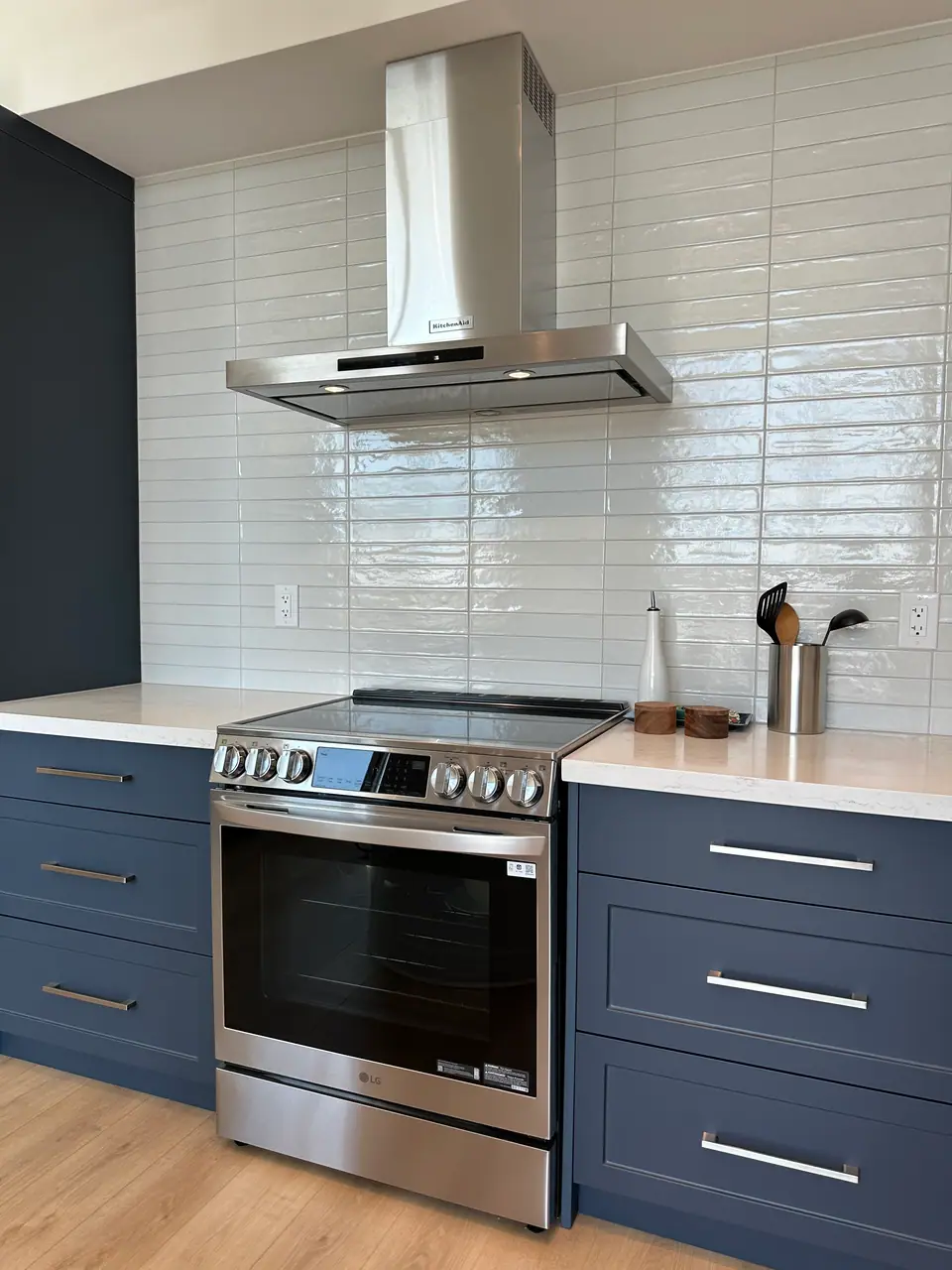
Lower sheens hide small dents and brush or spray marks; higher sheens are easier to wipe but show every flaw. Very dark and very saturated colours show wear at edges sooner than mid-tones, because chips and worn edges contrast more sharply against a dark colour; see dark kitchen cabinet design.
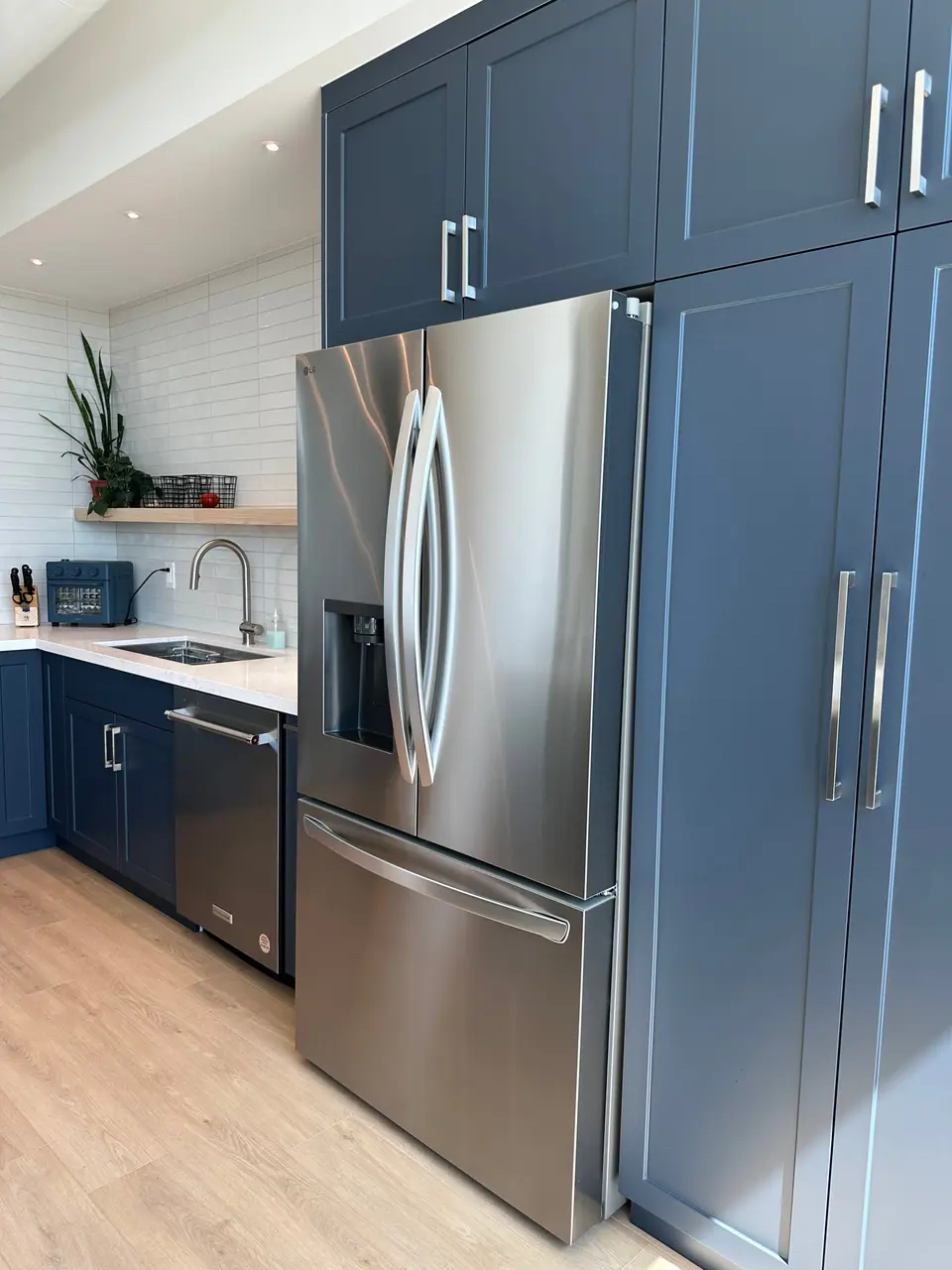
Colour does not have to be timid. A Toronto condo kitchen with city views uses bold blue with tall blue shaker pantry cabinets, a sage green kitchen in Toronto pairs sage cabinets with brass pendants, and a condo in the Beaches has a red statement kitchen. Pairing a colour with wood or a second paint colour is covered in two-tone kitchen cabinets.
Questions
Can I repaint my existing kitchen cabinets instead of replacing them?
Yes, if the boxes are sound and the layout works. Adhesion depends on thorough degreasing, sanding and the right primer, and the result will not match a factory catalysed finish for toughness. Compare options in cabinet refacing vs replacing.
Are painted MDF doors water resistant?
The painted faces are; the edges and any chip are the weak spots. The KCMA standard soaks door edges in detergent solution for 24 hours on painted and solid-wood doors to check for swelling. Wipe spills off the bottom edges of doors near the sink and dishwasher promptly.
How soon can I use cabinets that were painted on site?
Paint dries to the touch long before it reaches full hardness. Check the cure time on the product's data sheet before rehanging doors, loading shelves heavily or cleaning with anything stronger than a damp cloth.
Will the joint lines on my painted shaker doors get worse?
They usually open and close with the seasons rather than growing steadily. Steadier indoor humidity reduces the movement. A line that keeps widening or a joint that feels loose is worth having looked at.
Sources and further reading
- A Buyer's Guide to Kitchen Cabinets, Fine Homebuilding
- ANSI/KCMA A161.1-2022 Performance and Construction Standard for Kitchen and Vanity Cabinets
- Medium-density fibreboard, Wikipedia
- Kitchen cabinet, Wikipedia
Checked November 19, 2026. Codes, by-laws, prices and product specifications change; confirm with your municipality, condo corporation or supplier before you build.
Keep reading
Related guides