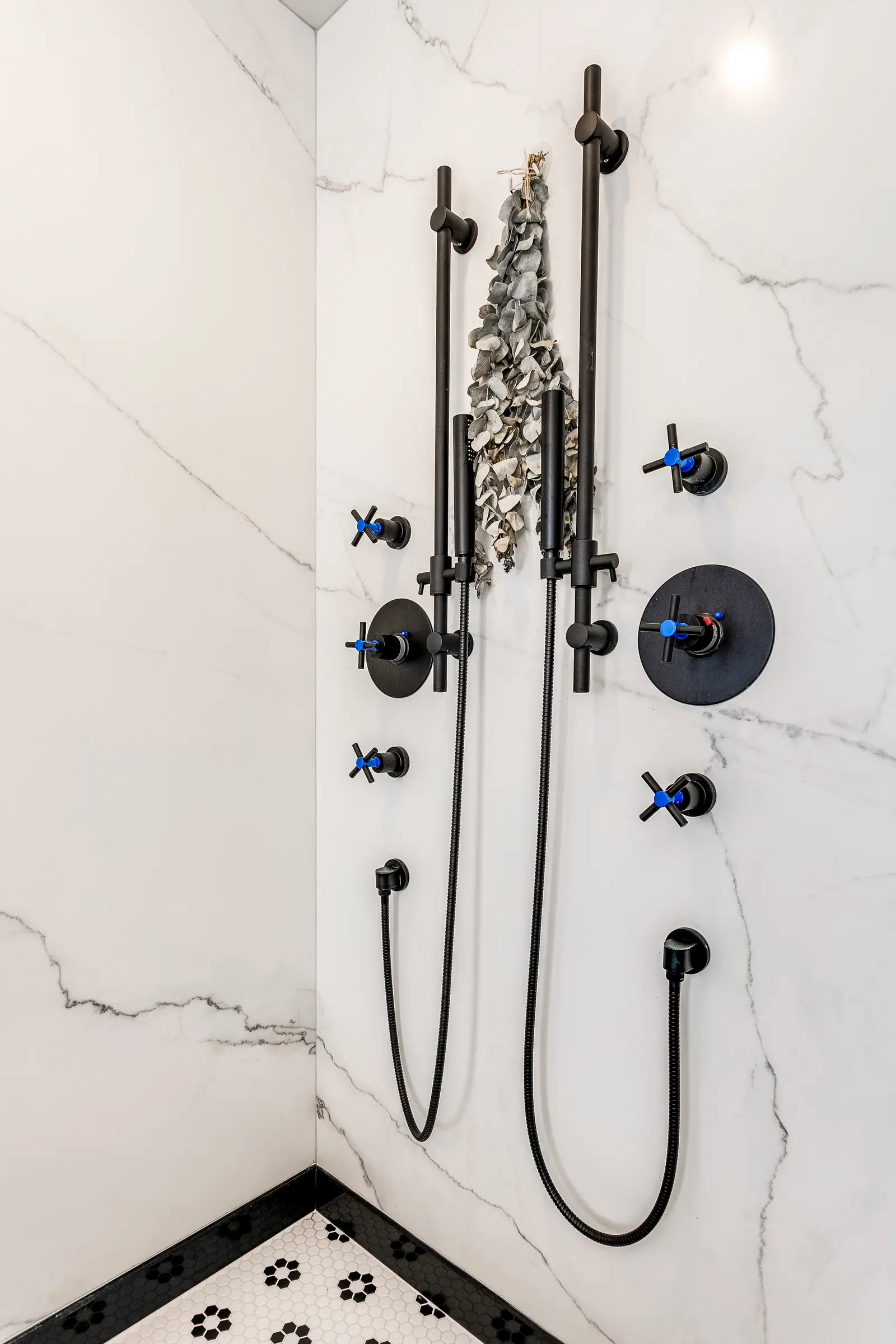
Bathroom tile
Mosaic tile in bathrooms
Mosaic tile, small pieces usually sold mounted on mesh or paper sheets, is the standard choice for a shower floor because it can follow the slope to the drain and its many joints give bare feet more grip. The price is grout: a 1-inch mosaic with 1/16-inch joints is about 11% grout by area, against under 1% for a 12 by 24 inch tile. Glass and stone mosaics need extra checks in a shower, because some backings, mortars and stones do not suit constantly wet areas.
Why shower floors are usually mosaic
A shower floor is not flat. Tile industry guidance from the Ceramic Tile Education Foundation calls for a stall shower floor sloped 1/4 inch per foot toward the drain; in its worked example, a floor whose farthest corner is 26 inches from the drain needs just over 1/2 inch of fall. With a centre drain the floor tilts in four directions at once, and only small pieces can follow those planes without lifted corners or a web of diagonal cuts.
Grip is the second reason. Each joint adds an edge underfoot, and Daltile's own guidance rates constantly wet, barefoot areas such as public showers for a higher wet DCOF (0.60) than ordinary bathroom floors (0.42). A home shower is not a public one, but the lesson holds: check the mosaic's slip rating and choose a matte face over a polished one.
Large tiles can work on a shower floor when a linear shower drain lets it slope in one plane. With a centre drain, mosaic remains the simplest match.
How much grout each tile size puts on the floor
Simple geometry shows why a mosaic floor takes more upkeep than a large-tile floor. The table assumes square-edged pieces and the joint widths shown.
| Tile size | Joint width | Share of floor that is grout | Length of grout line per square foot |
|---|---|---|---|
| 1 x 1 in. mosaic | 1/16 in. | About 11% | About 22.6 ft |
| 1 x 1 in. mosaic | 1/8 in. | About 21% | About 21.3 ft |
| 2 x 2 in. mosaic | 1/8 in. | About 11% | About 11.3 ft |
| 3 x 3 in. mosaic | 1/8 in. | About 8% | About 7.7 ft |
| 12 x 24 in. tile | 1/16 in. | Under 1% | About 1.5 ft |
Grout choice and joint width matter more on mosaic
With that much grout underfoot, the grout is the surface you live with. Epoxy and urethane grouts resist staining better than standard cement grout, compared in grout types: cement, epoxy and urethane. Grout close to the tile colour hides the grid and lets a mosaic read as texture; a contrasting grout turns the grid into the pattern.
Joint width is partly set by the tile, not by taste. ANSI A108.02 sets a minimum joint of 1/16 inch and requires the joint to be at least three times the actual size variation of the tiles supplied, so tumbled, handmade or irregular mosaics need wider joints than precise porcelain ones. The zellige and handmade tile guide covers the most irregular kind.
Sheets or individual pieces
Most mosaics come mounted: pieces held by a mesh or dot backing on the back, or by a paper sheet on the face that is soaked off once the tile is set. Sheets make a small-tile floor practical, since dozens of pieces go down at once with the spacing preset. The skill lies in hiding the sheets. The joints between sheets have to match the joints within them, or a faint grid of squares shows across the finished floor.
In a shower the backing matters. The Ceramic Tile Education Foundation warns that some glass tiles come with backings that may not be compatible with wet environments: fine on a kitchen backsplash, a problem in a shower. Check that a mosaic is rated for wet areas, and for floors if it is going underfoot, before you fall for it.
Individual pieces, set one by one, are for custom patterns, borders and cuts around a drain or curb. They take far longer, so they are usually kept to small areas such as an accent band or the back of a niche; see shower niche design.
Glass, stone and porcelain mosaics behave differently
The three common mosaic materials make different demands on the installer and on you.
- Porcelain mosaics are the easiest in a shower: dense, consistent in size, and often made to match a larger floor or wall tile, so the shower floor and the bathroom floor read as one surface.
- Glass mosaics come in cast, fused and coated types with different rules under the ANSI A137.2 glass tile standard. Translucent glass shows trowel ridges and the mortar colour behind it, and a mortar that bonds more strongly than a coated tile's backing can distort the coating. The Ceramic Tile Education Foundation advises getting the mortar requirements in writing from the tile and mortar makers.
- Stone mosaics add texture, but marble and limestone are acid-sensitive and some stones discolour when they stay wet. In one shower reviewed by the Foundation, a stone mosaic floor blotched within about a year, and the experts noted that some membrane makers say moisture-sensitive stone should not be used with their systems. Read the waterproofing maker's instructions before choosing stone for a shower floor.
Questions
Why can I see squares in my mosaic floor?
The joints between sheets do not match the joints within them. Installers adjust the spacing as each sheet goes down, and sometimes cut sheets apart, so the grid disappears. Once the grout has cured, the only fix is lifting and resetting the affected sheets.
Does a shower mosaic have to match the rest of the bathroom floor?
No. A mosaic cut from the same porcelain as the main floor makes a small bathroom look calmer, while a contrasting mosaic turns the shower into a feature. Either way, plan how the two meet at the curb or the entry so the change of material looks deliberate.
Are glass mosaics safe on a shower floor?
Only when the maker rates that product for floors and wet areas and publishes a suitable wet DCOF. Some glass is made for walls only. Check the backing too, since some glass tile backings are not suited to constantly wet areas.
Is a mosaic shower floor hard to keep clean?
It has more grout to look after, roughly 7 to 15 times the length of grout line per square foot of a 12 by 24 inch tile floor. A stain-resistant grout, a squeegee after showers and a fan that clears the humidity keep it looking new.
Sources and further reading
- Ceramic Tile Education Foundation: In showers, everything must slope to the drain
- Ceramic Tile Education Foundation: How to install glass tile correctly
- Ceramic Tile Education Foundation: How to deal with tile discoloration in showers
- Ceramic Tile Education Foundation: Credit card grout joints and tile industry standards
- Daltile: What is DCOF?
Checked November 19, 2026. Codes, by-laws, prices and product specifications change; confirm with your municipality, condo corporation or supplier before you build.
Keep reading
Related guides