Bathroom design
Bathroom wallpaper: where it works
Wallpaper works best in a powder room, where there is no shower, and on the dry walls of a full bathroom: above a tiled wainscot, behind the toilet, or on the vanity wall above a stone or tile backsplash. Keep it out of shower and tub surrounds, which Ontario's Building Code requires to have a waterproof finish, and out of the splash zone at the sink. Choose a wipeable paper, hang it over a proper primer, and run the fan until the room is dry.
Which bathrooms and walls suit wallpaper
The question is never whether a bathroom can have wallpaper, but which walls can. Paper fails where water lands on it or where steam sits on it for long periods, so the dry, well-ventilated walls are the ones to paper. The table sorts the common cases.
| Room or wall | Verdict | Why |
|---|---|---|
| Powder room (toilet and sink only) | Best fit | No shower, so the only moisture is hand washing |
| Ensuite or main bath, walls away from the shower | Works with a good fan | Steam reaches every wall, but briefly if the fan clears it |
| Above a tiled wainscot | Works well | Tile takes splashes on the lower wall; paper stays above them |
| Separate toilet room | Works well | NKBA recommends its own fan and switch for a toilet compartment |
| Kids' or family bathroom | Above tile only | Splashing and hard cleaning wear paper out at child height |
| Basement bathroom | Weigh carefully | Health Canada lists basements among common problem areas for poor ventilation |
| Inside a shower or tub surround | No | The Building Code requires a waterproof finish there |
The Building Code keeps paper out of the wet zones
Ontario's Building Code (Article 9.29.2.1) requires a waterproof wall finish to at least 1.8 m above the floor in a shower stall, 1.2 m above the rim of a bathtub with a shower, and 400 mm above the rim of a bathtub without one. Wallpaper is not a waterproof finish, so those zones get tile, stone or slab. In practice, paper stays outside the shower enclosure entirely, even above the required height, because that is where steam is heaviest.
The tub-only figure is the useful surprise. A soaking tub with no shower needs waterproof finish only 400 mm above its rim, so a papered wall above a tiled band behind a freestanding or alcove tub is possible, if the paper is wipeable. The vanity wall follows the same logic: run a stone or tile backsplash behind the faucet, where water actually lands, and start the paper above it.
Vinyl or non-woven: what the paper is made of matters in a damp room
Most bathroom papers are one of a few types, and they behave differently around moisture. Paper-backed vinyl is the most common, and the professional hanger This Old House consulted finds it easier to work with than plain paper; its vinyl face wipes clean. Non-woven papers are made from a fibre blend that does not expand when wet, so the paste is rolled onto the wall rather than the paper, which makes them quick to hang and easy to align.
There is one caution with heavy vinyl. Building Science Corporation, a building-science consultancy, calls vinyl wall coverings vapour semi-impermeable and links them on the inside of air-conditioned walls to mouldy buildings, because summer moisture moving inward is trapped behind them. A Toronto house running air conditioning through a humid summer is that case, so keep solid vinyl off exterior walls and save it for interior partitions.
| Type | Surface | Hanging | Best bathroom use |
|---|---|---|---|
| Paper-backed vinyl | Wipeable vinyl face | Often prepasted; paper is booked before hanging | Interior walls of ensuites and family baths |
| Solid or fabric-backed vinyl | Heavy and durable | Harder to cut precisely | High-wear walls, not exterior walls |
| Non-woven | Varies by product | Paste the wall; does not expand when wet | Powder rooms and exterior walls |
| Uncoated paper, grasscloth, natural fibres | Cannot be wiped like vinyl | Specialist hanging | Powder rooms only |
Primer, prep and seams are where bathroom wallpaper fails
Peeling almost always starts at a seam or an edge, and the cure is preparation. This Old House's guide starts with a universal wall-covering primer, which helps paper grip slick surfaces and stops porous ones from soaking up the paste, then roll every seam flat and wipe off excess paste. Let the paper dry completely before mirrors and fixtures go back up.
In older Toronto houses with plaster walls, the plaster needs repairing first: wallpaper shows every crack and bump beneath it. A lining paper hung first can even out minor defects. Finish the paper at a tile edge or a trim piece rather than tucking it behind the backsplash, and deal with any lifting corner as soon as it appears. Bathroom renovation in an older Toronto home covers what plaster walls involve.
Ventilation keeps the paper on the wall
Wallpaper in a full bathroom lasts as long as the room dries out after each shower. Health Canada advises running the bathroom fan while showering and letting it run a few minutes afterwards, and keeping indoor humidity between 30% and 50%. NKBA's guidelines suggest at least 60 CFM for a bathroom, a timer that runs up to 60 minutes, and humidity-sensing or motion controls so the fan runs without anyone remembering to switch it on.
The fan only works if it is ducted outdoors and sized for the room; bathroom exhaust fans and ventilation covers Ontario's rules. If a bathroom has no fan, or one that hums without moving air, fix that before ordering paper.
Two GTA projects that use wallpaper well
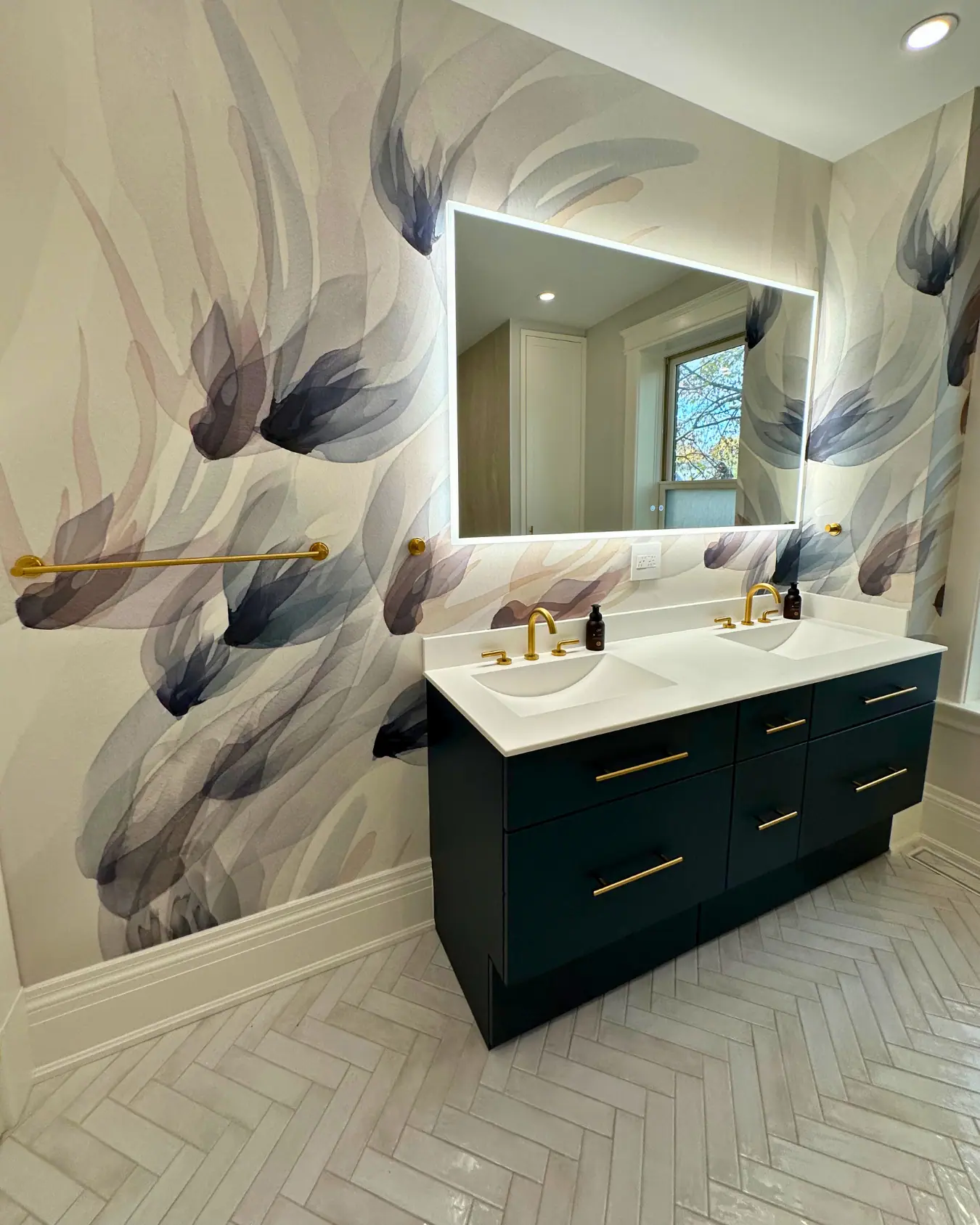
The wallpapered bathroom renovations in Toronto are two bathrooms built around bold patterned wallpaper and deep blue tile, a pairing that suits the rule on this page: tile where water lands, paper where it does not.
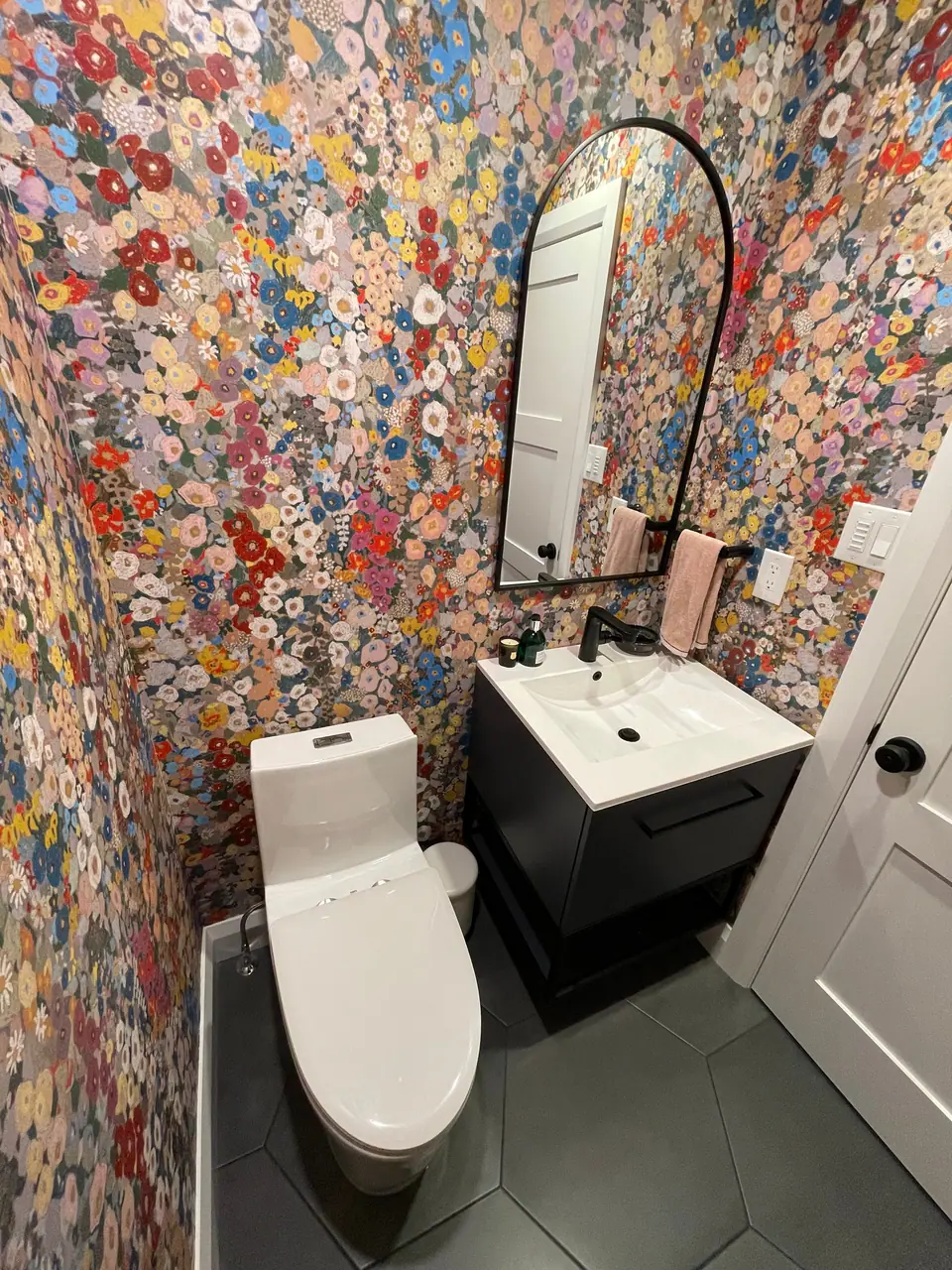
In Vaughan, the full-home renovation behind the modern kitchen renovation in Vaughan included a powder room upgrade, papered in a bold floral behind a black floating vanity. With no shower in the room, a powder room is where a strong pattern carries the least risk; powder room renovation covers the rest of the plan.
Questions
Can you wallpaper a bathroom that has a shower?
Yes, on the walls outside the shower enclosure, provided an exhaust fan ducted outdoors clears the steam after each shower. Inside the enclosure, the Building Code calls for a waterproof finish, so tile, stone or slab goes there.
Will wallpaper hide cracked plaster in an older bathroom?
No, it tends to show cracks and bumps. Repair the plaster, remove loose material and old adhesive, then prime. A lining paper hung first can smooth minor defects before the decorative paper goes up.
Can wallpaper go behind the sink?
Behind the mirror, yes. Directly behind the faucet, no: that is where splashes land, so run a backsplash of tile, stone or the counter material up the wall and start the paper above it.
Do bathroom wallpapers need a special paste?
Use the adhesive the paper's manufacturer specifies, over a wall-covering primer. Non-woven papers are pasted on the wall rather than on the paper, and prepasted vinyls are activated with water, so follow the instructions for the specific product.
Sources and further reading
- 2024 Ontario Building Code compendium, Part 9: Housing and Small Buildings (Article 9.29.2.1)
- Building Science Corporation, BSD-106: Understanding Vapor Barriers
- This Old House: How to wallpaper a small bathroom
- Health Canada: Reduce humidity, moisture and mould in your home
- NKBA Kitchen & Bath Planning Guidelines, design competition summary (2023)
Checked November 19, 2026. Codes, by-laws, prices and product specifications change; confirm with your municipality, condo corporation or supplier before you build.
Keep reading
Related guides