Vanity tops
Bathroom countertop materials
For most vanities, quartz and porcelain are the lowest-upkeep bathroom countertop materials: both are non-porous and need no sealer. Marble gives the most character but etches when acids touch it, granite resists acids far better, and acrylic solid surface is the one you can sand back and the usual route to a sink and top in one piece. Choose for what a bathroom actually puts on a counter: standing water, limescale, cosmetics and hot styling tools.
A vanity top faces different hazards from a kitchen counter
A vanity rarely meets a hot pan or a knife, so two of the big kitchen worries fall away. What it does meet is water left standing around the faucet deck and sink edge, a daily film of hard-water mineral, nail polish, hair products and fragrance, and styling tools that stay hot for as long as they are switched on. Those are the tests to judge each material by.
- Water and limescale: Caesarstone's care manual notes that limescale shows more on dark surfaces, and that honed, natural and textured finishes need more cleaning than polished ones.
- Heat: curling irons and flat irons are the bathroom's version of the hot pan, and quartz and porcelain handle them differently.
- Chemistry: acids etch marble and limestone, and the hydrofluoric acid in some rust removers and toilet bowl cleaners attacks every natural stone.
- Size: a single-sink top is a small piece, so ask the fabricator whether an offcut from a larger slab, often called a remnant, fits your vanity; it can open up materials that a full slab would put out of reach.
Vanity top materials side by side
The table compares the materials most often used on GTA vanities. Kitchen counter comparisons focus on cooking; this one focuses on the bathroom's own wear.
| Material | What it is | Strengths on a vanity | Watch for |
|---|---|---|---|
| Quartz | Engineered slab of crushed quartz bound with resin | Non-porous, no sealing, consistent colour | Resin can scorch under hot styling tools; use a heat mat |
| Porcelain slab | Thin, fired and vitrified ceramic sheet | Non-porous, takes heat, can match porcelain wall tile | Protect edges from hard knocks; keep drain and toilet cleaners off |
| Marble | Calcareous natural stone | Veining no other slab repeats | Etched by acids; stains without prompt wiping |
| Granite | Siliceous natural stone | Resists most household acids; hard wearing | Many slabs need no sealer, but hydrofluoric acid still harms it |
| Acrylic solid surface | Acrylic polymer and alumina trihydrate, coloured through | Near-invisible joints, integrated bowls, scratches can be buffed out | Heat resistant only to about 100°C; scratches show on dark colours |
| One-piece vitreous china top | Glazed ceramic top with the bowl formed in | Easy to wipe, no joint at the bowl | Set sizes and shapes; a chip or crack means a new top |
Quartz and porcelain differ most around a hot curling iron
Both are non-porous and finished without sealers or wax, and Caesarstone's care manual for its quartz and porcelain surfaces asks for no more than warm soapy water and a damp cloth day to day. Dried spills, nail polish included, are lifted with a putty knife and the spot wiped with a damp cloth.
Heat is where they part. Caesarstone recommends a trivet on quartz to stop the resin burning. Porcelain will take cookware straight from the oven, yet the same manual says devices that give off constant heat over a long period belong on an insulated mat, not on the porcelain. A curling iron or flat iron left to heat up on the counter is exactly that kind of device, so plan a heat-proof mat, or a holder on the wall for hot tools, whichever top you choose.
The manual's list of things to keep off includes hydrofluoric acid and oil-based cleaners or polishes, which leave a film that makes the surface more prone to staining. For porcelain it adds oven cleaners, toilet bowl cleaners, drain products and cleaners made for natural stone. Rinse any cleaner off and dry the top afterwards, because cleaner residue and evaporating water are what build limescale.
Marble and granite on a vanity: chemistry sets the care
The Natural Stone Institute sorts stone into two groups. Calcareous stones, including marble, limestone and travertine, are mostly calcium carbonate, which acids attack, so lemon, vinegar and acidic cleaners dull or etch them. Siliceous stones such as granite are made mainly of silicate minerals and resist most household acids, although acidic cleaners are still not recommended.
On a vanity that means wiping spills promptly, keeping perfume and toiletries on a tray, and cleaning with a neutral stone cleaner or mild dish detergent. Never use rust removers or toilet bowl cleaners on the counter: the Institute notes many contain trace hydrofluoric acid, which attacks every stone, granite and quartzite included. Stone sealers are impregnators that make a slab more stain resistant, not stain-proof, so ask the supplier whether yours needs one.
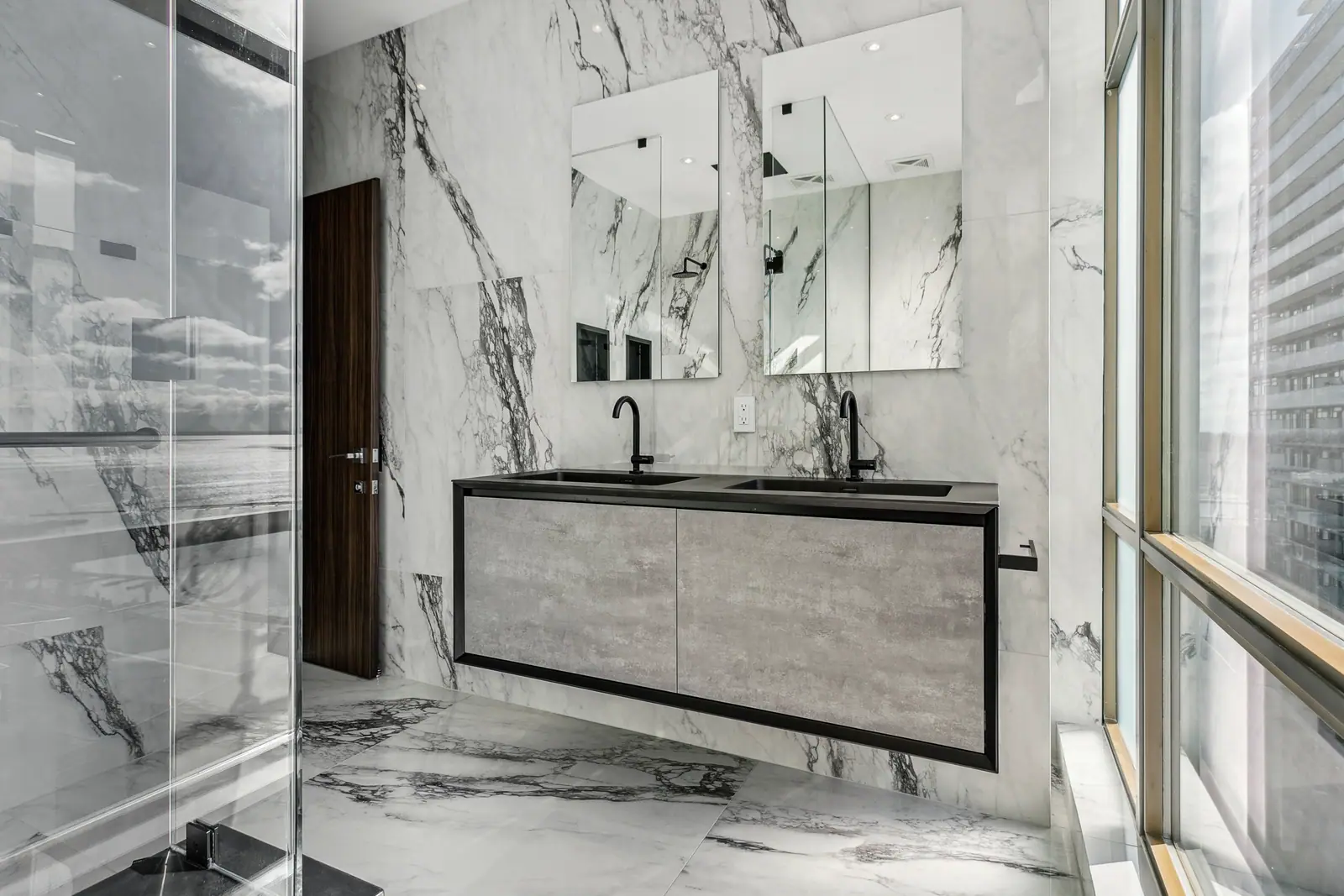
Marble is a fair choice for an ensuite whose owners welcome a patina; marble bathrooms covers the trade-offs. For a finished example of slab surfaces in a bathroom, the herringbone bathroom in High Park pairs them with a navy double vanity and brushed gold fixtures.
Solid surface and one-piece tops with integrated basins
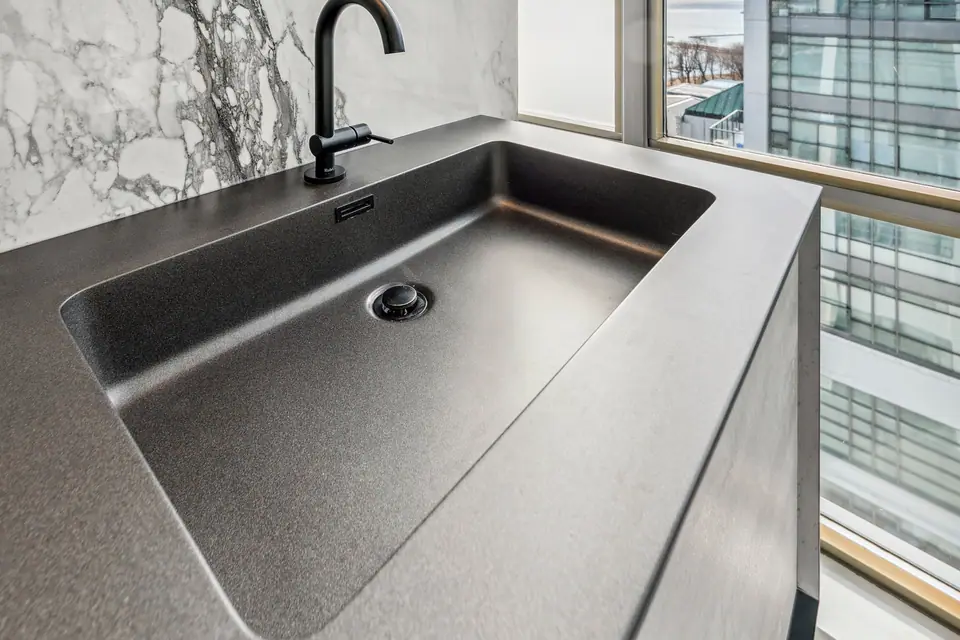
If you want the counter and sink as one continuous piece, solid surface is the classic material. Corian, the original brand from DuPont, is acrylic polymer and alumina trihydrate with the colour running through its full thickness, made in 6, 12 and 19 mm sheets. Pieces are joined with a colour-matched acrylic adhesive and sanded so the joint all but disappears, the material can be heat-formed into curves, and cuts and scratches can be abraded and buffed out. It is heat resistant only to about 100°C (212°F), so hot tools need a mat here too.
One-piece vitreous china tops, with the bowl formed in the same glazed piece, are the other common integrated option. Integrated basins leave no rim or caulk line to clean around, but bowl and counter share one fate: serious damage to either means a new top.
The basin is a plumbing fixture whatever it is made of. Ontario's Building Code (Article 7.2.2.2) requires vitreous china fixtures to conform to CSA B45.1 and plastic fixtures to CSA B45.5/IAPMO Z124, so check the spec sheet of any integrated top for that certification. Bathroom sink types compares integrated basins with undermount and vessel sinks.
Edges, splashes and faucet holes are settled at templating
A few small choices decide how easy the top is to live with, and they are fixed when the fabricator templates the vanity.
- Edge: a simple eased or square edge is easier to wipe than an ogee or bevel, which collects toothpaste and scale.
- Splashes: add a side splash wherever the top meets a wall, or run the wall tile or a slab backsplash down to the counter instead of a short splash with a grout line behind it.
- Faucet holes: drilled for a single-hole, centreset or widespread faucet, so the faucet has to be chosen first; the bathroom vanity buying guide covers the sequence.
- One slab for all pieces: cut the top, splashes and any matching shelf from the same slab or remnant so the colour and veining match.
Questions
Can a hot curling iron sit on a quartz vanity?
Not directly. Caesarstone recommends a trivet on quartz to keep the resin from burning, and even its porcelain, which takes oven-hot cookware, should sit under a mat when a device gives off constant heat for a long time. A heat-proof mat or a wall holder solves it.
Is a remnant big enough for a bathroom countertop?
Often, for a single-sink vanity. Ask the fabricator which offcuts it has in your size, and make sure the piece covers the top, any side splash and the backsplash so the colour matches throughout.
Which vanity top is most forgiving in a kids' bathroom?
Quartz and solid surface are the usual picks. Quartz resists everyday spills and needs no sealing; solid surface can have scratches and small burns sanded and buffed out. Marble is the least forgiving of acidic spills and gritty cleaners.
How do I remove limescale from a vanity top?
On quartz and porcelain, Caesarstone suggests a non-abrasive cream cleaner, or a 50/50 mix of vinegar and water followed by a rinse and a thorough dry. Never use vinegar on marble, limestone or travertine; use a neutral stone cleaner there and wipe the top dry daily to stop the build-up.
Sources and further reading
- Caring for your Caesarstone quartz, porcelain and ICON surfaces (Canada)
- Natural Stone Institute: Care and cleaning for natural stone
- Wikipedia: Corian (solid surface composition and properties)
- Ontario 2024 Building Code Compendium, Part 7: Plumbing (Article 7.2.2.2)
Checked November 19, 2026. Codes, by-laws, prices and product specifications change; confirm with your municipality, condo corporation or supplier before you build.
Keep reading
Related guides