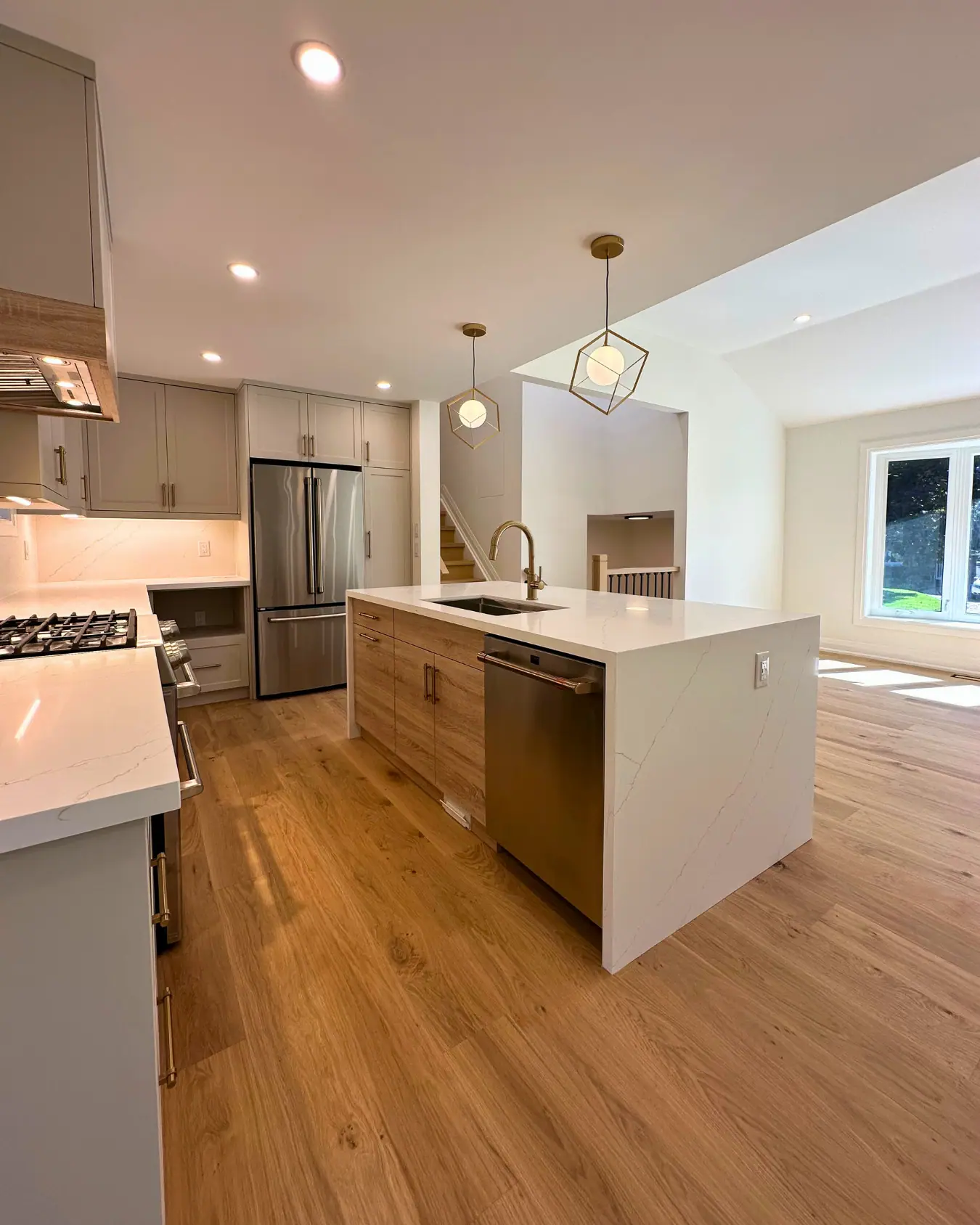
Stone comparison
Quartz vs quartzite
Quartz is a manufactured slab of crushed quartz bound with resin and pigment; quartzite is a natural metamorphic rock formed when quartz-rich sandstone recrystallizes under heat and pressure. Quartzite tolerates heat and sunlight and has no resin to discolour, but its porosity varies and every slab is unique. Quartz is uniform and never needs sealing. The costliest mistake is paying for quartzite and receiving marble or dolomite, so test a sample before you sign.
Engineered slab or metamorphic rock: where each comes from
The names are a coincidence of mineralogy, not a sign the products are related. Engineered quartz is made in a factory: Caesarstone describes its slabs as roughly 90% loose quartz, with the rest resins and pigments, pressed and cured into a uniform sheet. Its colour, pattern and thickness are set by the manufacturer, and the spec sheet tells you exactly what you are buying.
Quartzite is quarried. It starts as sandstone made mostly of quartz grains, then heat and pressure deep in the earth fuse those grains into a dense rock. ASTM C616, the standard for quartz-based dimension stone, sorts this family into three classes by free-silica content: sandstone, quartzitic sandstone and quartzite. A slab's commercial name, by contrast, is chosen by whoever sells it, and that is where buyers get into trouble.
Three products sold under two names
A fair comparison needs a third column, because stone yards sometimes label marble or dolomite as quartzite. Each behaves very differently on a kitchen counter.
| Point to check | Engineered quartz | True quartzite | Marble or dolomite labelled quartzite |
|---|---|---|---|
| Made of | Crushed quartz, resin, pigment | Fused quartz grains | Calcite or dolomite |
| Scratching a glass tile | Not needed: the spec sheet says what it is | Bites into glass with a gritty sound | Slides across and leaves a powdery smear |
| Lemon juice or vinegar for 5 to 10 minutes | Wipe promptly and follow the maker's cleaning list | No etched spot | Dull etched spot; dolomite etches more slowly |
| Sealing | Never | Depends on the slab: some are porous | Seal against stains, but sealer will not stop etching |
| Sun and outdoor use | Standard resin is UV-sensitive | No resin binder to fade | Acidic spills and cleaners etch it, indoors or out |
| Pattern | Repeatable from slab to slab | Unique to each slab | Unique to each slab |
The identification mistake that costs homeowners most
The most expensive error in this comparison is not choosing quartz over quartzite or the reverse; it is buying a slab called quartzite that is really marble. Geologist Karin Kirk, writing for UseNaturalStone.org, puts it bluntly: there is really no such thing as soft quartzite, and in most cases that term means the stone is marble. In her own test, a stone sold as soft quartzite etched under acid, confirming it was marble.
Dolomite is the subtler case. It is related to marble and etches more slowly than calcite, so a quick acid test can look inconclusive. Some dolomitic stones contain a little quartz and may scratch glass weakly or inconsistently. That is why no single test settles the question: run the glass test and the acid test together and believe the combined result, not the label.
The consequence of getting it wrong shows up within weeks. A marble counter will etch where lemon, wine, tomato or vinegar sits, and no sealer prevents etching, because sealers protect against absorption, not acid.
How to test a quartzite sample before you sign
Ask the supplier for an offcut or sample from the slab you are buying, and get permission before testing any full slab. The steps below follow the UseNaturalStone.org method.
- Glass test: press a sharp, broken edge of the sample into a glass tile and drag it firmly. True quartzite leaves a real scratch. Rub the mark with your finger: if it wipes away, it was powder from a softer stone. Test several spots on multicoloured stone.
- Acid test: place several large drops of lemon juice or vinegar on the polished face for 5 to 10 minutes, wipe, then look at a low angle for dull patches. Polished finishes show etching more clearly than honed or leathered ones.
- Water test: stand the sample partly in shallow water, or dribble water on it, for 10 to 15 minutes, dry it and wait about 10 minutes. A darkened area means the stone absorbs liquid and should be sealed.
- Keep the sample: label it with the slab number so the stone delivered can be matched to the stone tested.
Sealing, staining and everyday care
Quartz is the no-maintenance option: it is non-porous and needs no sealer, ever. The care rules are about the resin: use a trivet under hot cookware, as Caesarstone's care manual recommends, use a cutting board, and avoid the harsh chemicals the maker lists.
Quartzite care depends on the individual slab. Hardness is not the same as density, and the UseNaturalStone.org testing found that some genuine quartzites are porous. If the water test darkens your sample, seal the installed counter and repeat the water test periodically: when drops start darkening the stone again, it is time to reseal. A dense quartzite may need little or nothing. Full detail on choosing and living with the stone is on quartzite countertops.
Heat, UV and outdoor kitchens
Quartzite has the edge wherever heat or daylight is intense, because there is no resin binder to scorch or fade. Caesarstone's outdoor FAQ explains that the resin in its standard quartz is relatively sensitive to UV, so colour changes over time outdoors; it sells a separate outdoor line with UV-stable resin for that purpose.
That makes true quartzite a strong candidate for a backyard kitchen, a sunroom counter or a kitchen with floor-to-ceiling south-facing windows. Some natural slabs are resin-filled at the factory to close small fissures, so if the counter will live outside, confirm with the supplier that the specific slab is suited to exterior use. Indoors, under ordinary light, UV is not a reason to avoid quartz.
Quartzite or quartz: making the call
Both are excellent kitchen surfaces once you know which one you are getting.
- Quartzite is the right call when you want natural stone with the veined look of marble but far better resistance to etching, the counter faces strong sun or sits outdoors, you like setting hot pans down, and you are willing to test the slab and seal it if it proves porous.
- Quartz is the right call when you want a predictable pattern that matches across several slabs, a surface that never needs sealing, and a buying process with no identification risk.
- Walk away from any slab that etches under lemon juice or will not scratch glass but is priced and sold as quartzite.
Questions
Is quartzite harder to scratch than quartz?
True quartzite scratches glass and resists a steel knife tip, which is why the glass test works. Engineered quartz also resists scratching well, but its resin is the weaker part. On either surface, use a cutting board, because fine marks can still show on polished finishes.
Will a sealer stop lemon juice from marking my 'quartzite'?
No. Sealers reduce absorption, not acid attack. If lemon juice or vinegar leaves a dull spot after a few minutes, the stone contains calcite or dolomite and is marble or dolomite, whatever the label says. Genuine quartzite should not etch from ordinary kitchen acids.
Can I use quartzite in a bathroom vanity or shower?
Yes. Quartzite's resistance to etching suits a vanity where toiletries and cleaners are used daily. Run the water test first: a porous slab used in a shower or around a sink should be sealed, and resealed when water starts darkening it again.
Why do quartz and quartzite have such similar names?
Both contain the mineral quartz. Quartzite is almost entirely quartz grains fused naturally, while engineered quartz is crushed quartz bound in resin. The shared root word describes the mineral, not the product, and it is the main reason buyers mix them up.
Sources and further reading
- UseNaturalStone.org: How to be your own stone sleuth (Karin Kirk)
- ASTM C616/C616M: Standard Specification for Quartz-Based Dimension Stone
- Caesarstone Canada: Quartz countertops, the comprehensive guide
- Caesarstone: Outdoor FAQs (UV sensitivity of standard quartz resin)
- Caesarstone Canada: Care and maintenance manual
Checked November 19, 2026. Codes, by-laws, prices and product specifications change; confirm with your municipality, condo corporation or supplier before you build.
Keep reading
Related guides