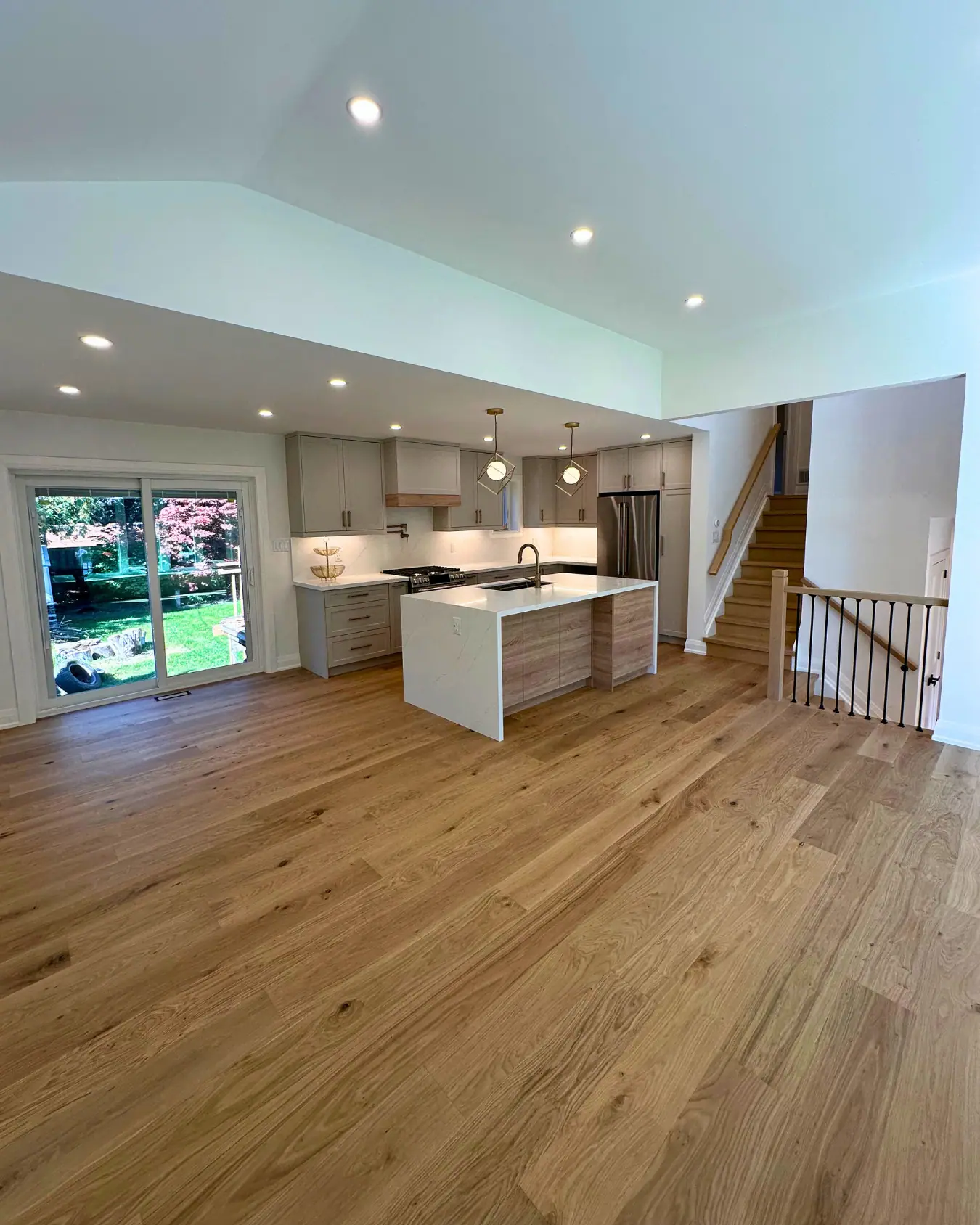
Countertop comparison
Quartz vs granite countertops
Quartz is an engineered slab made of roughly 90% crushed quartz bound with resins and pigments; granite is natural igneous rock quarried and sawn into slabs. Pick quartz for consistent colour, zero sealing and the easiest daily care. Pick granite for a one-of-a-kind natural pattern that tolerates hot pans, sunlight and outdoor kitchens. Both wear well for decades, so the decision comes down to looks, heat and how much upkeep you accept.
How quartz and granite differ, trait by trait
The two surfaces are close on price and durability, so the useful comparison is on the traits where they genuinely part ways. The table below sets them out; the sections after it explain the ones that change a buying decision.
| Trait | Quartz (engineered) | Granite (natural) |
|---|---|---|
| What the slab is | About 90% quartz with resins and pigments, made in a factory | Igneous rock cut from a quarry block |
| Colour from slab to slab | Consistent: the sample matches the delivered slab | Every slab differs: you approve the actual slab |
| Sealing | Never needed; the surface is non-porous | Most granites do not need it; a quality sealer lasts 10 to 15 years |
| Hot cookware | Use a trivet; very hot pans can leave a mark | Tolerates heat well |
| Sunlight and outdoor use | Standard resin is UV-sensitive and can change colour outside | No resin binder to fade; used for exterior work |
| Crystalline silica in the raw slab | Can exceed 90%, up to 97% in some products | About 20% to 45%, typically around 30% |
| What drives the price | Brand, design complexity, thickness | Colour rarity, slab thickness, availability |
Does granite need sealing, and does quartz?
Granite needs less sealing than its reputation suggests, and quartz needs none. The Natural Stone Institute states that most granite countertops do not need to be sealed, and notes that many granites are resin-treated at the factory to fill tiny fissures. Sealing can still make sense because it slows liquid entering the stone; the Institute recommends an oleophobic sealer, one that resists both water- and oil-based stains, with a life expectancy of ten to fifteen years.
A simple check tells you whether your slab is one that benefits. Consumer guidance on UseNaturalStone.org suggests dribbling water on the surface, waiting 10 to 15 minutes, drying it and looking for a darkened patch. If the stone darkens, it absorbs liquid and a sealer is worth applying; if it stays the same, the slab is dense enough to leave alone.
Quartz is non-porous, so penetrating sealers are not recommended for it at all. That does not make it stain-proof: an industry article in Construction Canada notes that stains on quartz can come from chemical reactions with its resin, which is why makers publish a list of cleaners to avoid. Day to day, quartz is the lower-effort surface.
Heat, sunlight and outdoor kitchens favour granite
Granite is the better choice anywhere heat or ultraviolet light is constant. Quartz makers themselves say so: Caesarstone's Canadian care manual recommends a trivet under hot cookware on quartz to prevent burning, and its comprehensive quartz guide concedes that granite is virtually impossible to damage with heat.
Sunlight is the second dividing line. Caesarstone's outdoor FAQ explains that the resin in its regular quartz is relatively sensitive to UV, so colour changes over time when it is installed outside; the company makes a separate outdoor line with a UV-stable resin for that reason. Granite has no resin binder to discolour.
In a GTA home this matters in three places: a counter under a large south- or west-facing window, a sunroom or rear addition with skylights, and a backyard kitchen. For an ordinary indoor kitchen where you will use trivets anyway, heat and UV are not reasons to rule quartz out.
Why fabrication dust belongs in the quartz conversation
The silica issue concerns the people who cut countertops, not the people who cook on them, but it is a real difference between the two materials. Safe Work Australia's data puts crystalline silica in engineered stone at up to 97%, against 20% to 45% (typically about 30%) in granite. Breathing the fine dust made when slabs are sawn, ground and polished is what causes silicosis, a lung disease.
Australia acted on this: from 1 July 2024 it prohibited working with engineered stone that contains 1% or more crystalline silica, while natural stone such as granite and marble is outside the ban.
What it means for you: ask the fabricator how they control dust (water-fed cutting and extraction are the standard answers), and keep cutting inside your home to a minimum. Sink and cooktop cut-outs are normally made in the shop before the counter arrives.
Choosing a slab: catalogue consistency or one-of-a-kind stone
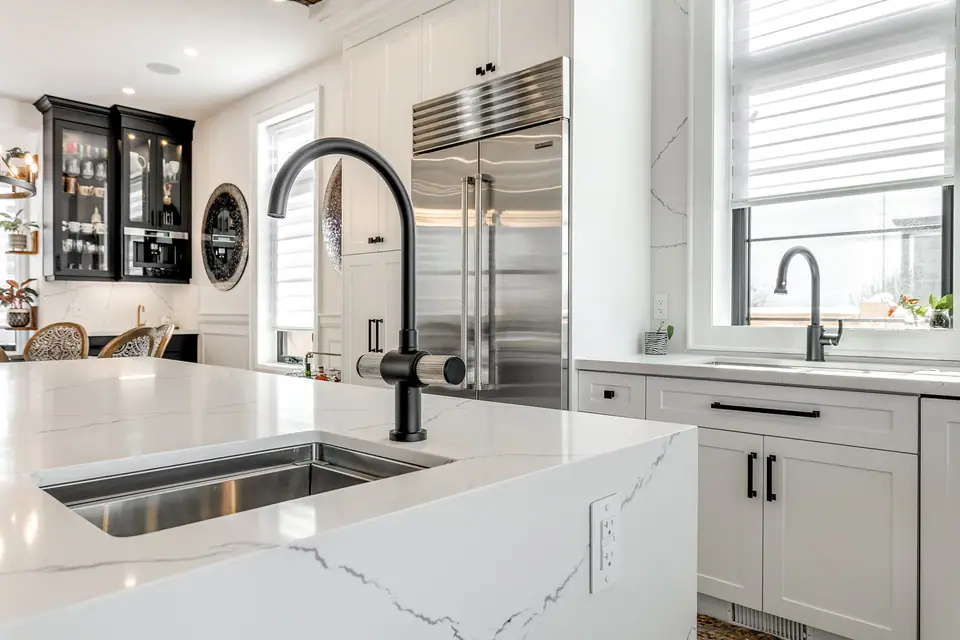
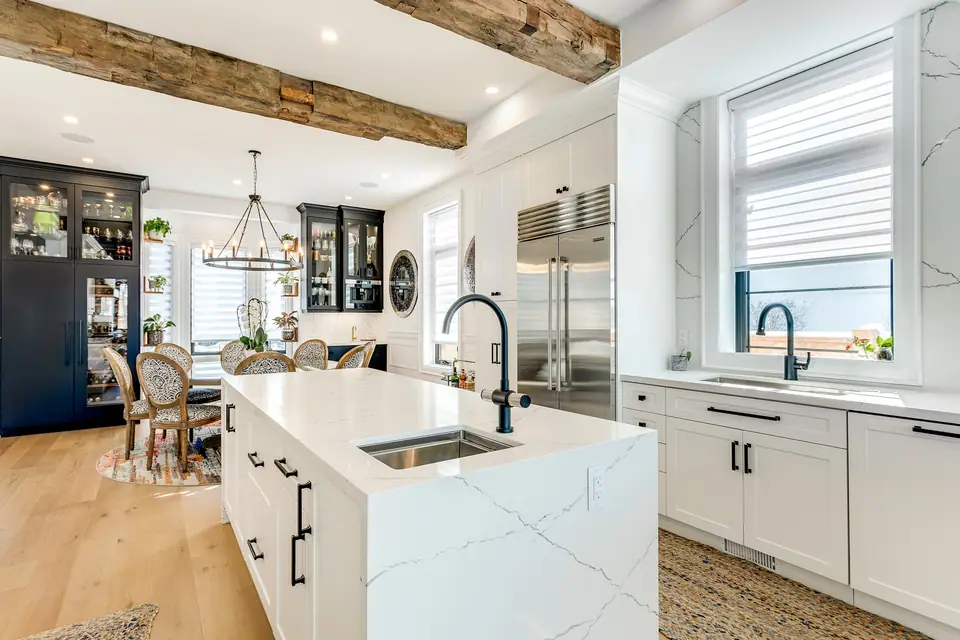
Quartz is chosen from a sample, granite from the slab itself. Because quartz is manufactured, the colour and pattern you see in a showroom chip are what arrives, and a second slab for a long island will match the first. That predictability is why quartz is the default for large continuous surfaces such as the waterfall islands in the Victorian kitchen renovation in Milton and the sage green kitchen renovation in Toronto.
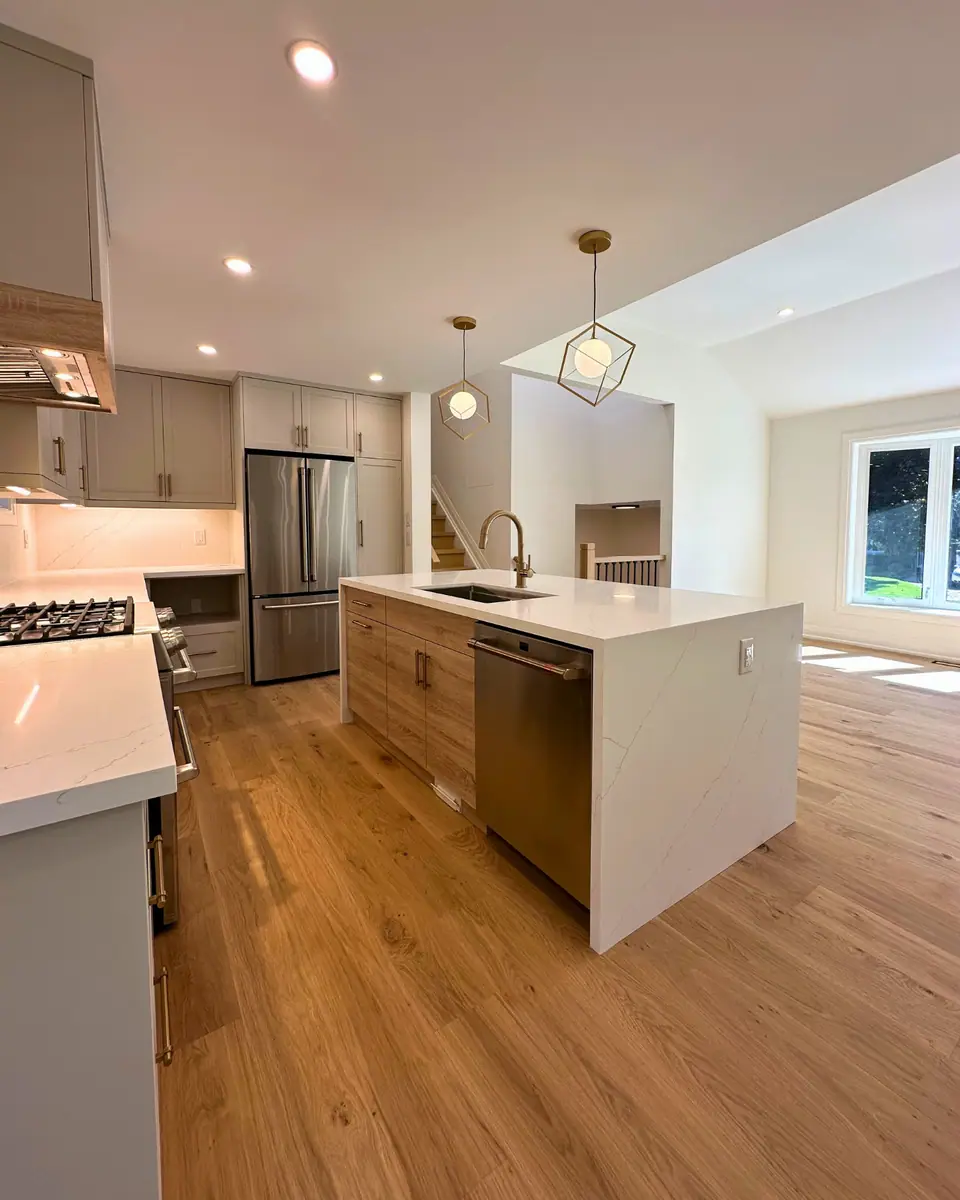
Granite rewards a visit to the slab yard. Movement, colour and mineral flecks vary from one slab to the next and even across one slab, so ask to see the full slabs you will receive, mark where seams and sink cut-outs fall, and approve the layout before cutting. For a modern take on the stone, see granite countertops in a modern kitchen.
On price the two overlap, and installed GTA ranges, cut-out charges and edge extras are broken down on quartz countertop cost. Depth on quartz grades and finishes lives on quartz countertops for kitchens.
The verdict: which countertop should you choose?
Neither material is the winner in every kitchen. Match the slab to how the room is used.
- Choose quartz if you want a uniform colour or a marble look without marble's upkeep, you never want to think about sealing, the counter is indoors and out of strong direct sun, and you are happy using trivets.
- Choose granite if you want a natural slab nobody else has, you set hot pans down without thinking, the counter sits in strong sunlight or outdoors, or you would rather avoid an engineered product with high silica content.
- Either works for a busy family kitchen: both resist scratches and everyday wear when you use a cutting board.
Questions
Can I put a hot pan straight onto granite?
Granite handles heat far better than quartz, and even quartz makers acknowledge it is very hard to damage with heat. A trivet is still a sensible habit near seams and on sealed or resin-treated slabs. On quartz, use one every time: the resin can mark under very hot cookware.
Do quartz countertops ever need sealing?
No. Quartz is non-porous, and penetrating sealers are not recommended on it. Clean it with warm soapy water and check the maker's list of chemicals to avoid, because stains on quartz usually come from a reaction with the resin rather than liquid soaking in.
Is it safe to have engineered quartz in my kitchen?
The documented health hazard is breathing the dust created when slabs are cut and polished, which is why Australia's 2024 ban targets work with the material. A finished, installed countertop is not being cut. If a quartz top ever needs trimming on site, it should be done wet or with dust extraction by the fabricator.
How can I tell if my existing granite needs resealing?
Drip some water on a few spots, including near the sink, and wait 10 to 15 minutes. Wipe it dry and look for darker patches. If the water has darkened the stone, reseal with a quality oleophobic sealer; if not, the slab is dense enough as it is.
Sources and further reading
- Natural Stone Institute: Sealing stone
- Caesarstone Canada: Quartz countertops, the comprehensive guide
- Caesarstone: Outdoor FAQs (UV sensitivity of standard quartz resin)
- Safe Work Australia: Engineered stone prohibition definition
- Construction Canada: Designing with porcelain slabs (quartz stains and sealers)
Checked November 19, 2026. Codes, by-laws, prices and product specifications change; confirm with your municipality, condo corporation or supplier before you build.
Keep reading
Related guides