Cabinet materials
White oak and walnut kitchen cabinets
White oak and walnut are the two hardwoods most asked for in wood kitchens, and they behave differently. White oak is harder (1,350 lbf on the Janka scale against walnut's 1,010), pale brown with an olive cast, and rot resistant because its pores are plugged with tyloses; walnut is darker, softer and moves more evenly with the seasons. On a cabinet door, the cut matters as much as the species: rift gives straight lines, quarter shows oak's ray fleck, plain sawn shows cathedral arches.
White oak and black walnut compared
Both are North American hardwoods whose native range reaches southern Ontario, and both last for decades in a kitchen. The differences show in colour, hardness and movement. The figures below are from the Wood Database.
- Movement: white oak's tangential shrinkage is high, so flat-sawn white oak changes width noticeably through the year; walnut's lower ratio means its movement is more even.
- Dents: walnut is softer, so a low drawer front that meets feet and chair legs will mark sooner.
- Availability: white oak is abundant in flat-sawn and quartersawn lumber; walnut boards can run narrow.
| Trait | White oak | Black walnut |
|---|---|---|
| Colour | Light to medium brown heartwood, often with an olive cast; paler sapwood | Pale brown to dark chocolate heartwood, sometimes grey, purple or reddish; sapwood pale yellow-grey to nearly white |
| Janka hardness | 1,350 lbf | 1,010 lbf |
| Shrinkage, green to oven-dry (radial / tangential) | 5.6% / 10.5% | 5.5% / 7.8% |
| Tangential to radial ratio | About 1.9 | About 1.4 |
| Dried weight | 47 lb per cubic foot | 38 lb per cubic foot |
| Decay resistance | Very durable; pores plugged with tyloses | Very durable heartwood |
| Price | Moderate for a domestic hardwood; quartersawn costs more | High for a domestic species; waste rises when pale sapwood is cut away |
Rift, quarter and plain sawn: three grain looks
How a log is cut decides what the grain looks like on a door, and with white oak this choice is as big as the species. Plain sawing cuts straight through the log and shows arched cathedral grain; it is the least expensive cut and the least stable. Quarter sawing turns the growth rings close to perpendicular to the face, giving straight stripes, the best stability and, in oak, the ray fleck long associated with Arts and Crafts furniture. Rift sawing cuts along the radius so the grain runs straight on every face, wasting more wood and costing accordingly.
The names are used loosely. Even the Wikipedia article on quarter sawing notes that rift and quarter sawn are sometimes defined with opposite meanings, so approve a physical sample of the actual cut rather than a word on a quote. Veneer uses the same family of names: plain sliced, quarter sliced and rift cut.
| Cut | On the door | Stability | Relative cost |
|---|---|---|---|
| Plain sawn or plain sliced | Cathedral arches and wavy figure | Least stable | Lowest |
| Quarter sawn or quarter sliced | Straight stripes with ray fleck in oak | Most stable | Higher |
| Rift sawn or rift cut | Tight, straight, linear grain | Stable | Highest, because of waste |
Veneer or solid wood: which parts should be which
Most wood kitchens use both. Fine Homebuilding's buyer's guide notes that slab doors are either glued-up solid wood or veneered MDF, that an MDF core helps keep a slab flat, and that a solid-wood door 18 or 20 inches wide may cup or twist over time. Five-piece doors use solid-wood frames around a solid or veneered panel. Large flat surfaces, such as slab doors, end panels and appliance panels, are where veneer over a stable core earns its place.
Veneer has two trade-offs. It is thin, sometimes as little as 0.64 mm (1/40 inch), so a damaged face can be scuffed and recoated but not sanded deeply. And a veneered panel can age slightly differently from a solid frame beside it, which Fine Homebuilding flags mainly for woods that change dramatically with age. In return, veneer lets a whole wall of doors come from one log, laid out in sequence so the grain flows across the run; kitchen cabinet door styles covers how slab and shaker doors are built.
Finishes: keep white oak pale or let it warm
The finish sets the colour almost as much as the wood. The Wood Database notes that linseed-oil-based finishes make light-coloured woods yellow and recommends water-based finishes to keep pale woods light, which is why white oak under an oil-based coat turns honey-toned and under a water-based clear coat stays closer to raw. Walnut is rarely stained; its own colour is the point.
For kitchen use, film-building finishes protect best, and protection improves sharply over the first few coats. Most cabinet makers spray a catalysed conversion varnish, a hard two-part coating; lacquer is easier to repair. Penetrating oils look natural but give the least protection against wear and water, so they suit open shelves better than a sink base.
- White oak and iron: the wood reacts with iron, especially when wet, and stains dark. Keep steel wool off it and wipe up water under cast-iron pans promptly.
| Finish | Look | Protection | Repair |
|---|---|---|---|
| Catalysed conversion varnish, factory sprayed | Clear, from matte to gloss | Very durable | Hard to blend; damaged fronts are often refinished whole |
| Lacquer | Clear | Durable | Easier to repair than catalysed finishes |
| Water-based clear coat | Keeps white oak closest to its raw colour | Good when built up in several coats | Can be recoated |
| Penetrating oil | Warm, low sheen; linseed-based oils yellow pale woods | Lowest | Easy spot repair, more upkeep |
How the colour changes over time
All wood changes colour. The Wood Database describes every board as having a freshly cut colour and a settled-in colour: most woods darken toward that settled colour and then stop, and oak is among the woods it says get better with age. UV light shifts the colour of some species, and several coats of a film finish slow the change. In practice, a toaster or fruit bowl left in one spot for months on a sunlit wood surface can leave an outline, so move things around in the first year, and judge any paint or stone you pair with the wood against an aged sample if you can.
Size changes follow the seasons. Heated GTA homes are dry in winter and humid in summer, so a solid-wood panel shrinks a little in January and swells in August; flat-sawn white oak moves the most, quartersawn the least. Steadier indoor humidity, for example a humidifier in winter, reduces that movement and the hairline gaps it can open.
White oak throughout: the Vaughan family kitchen
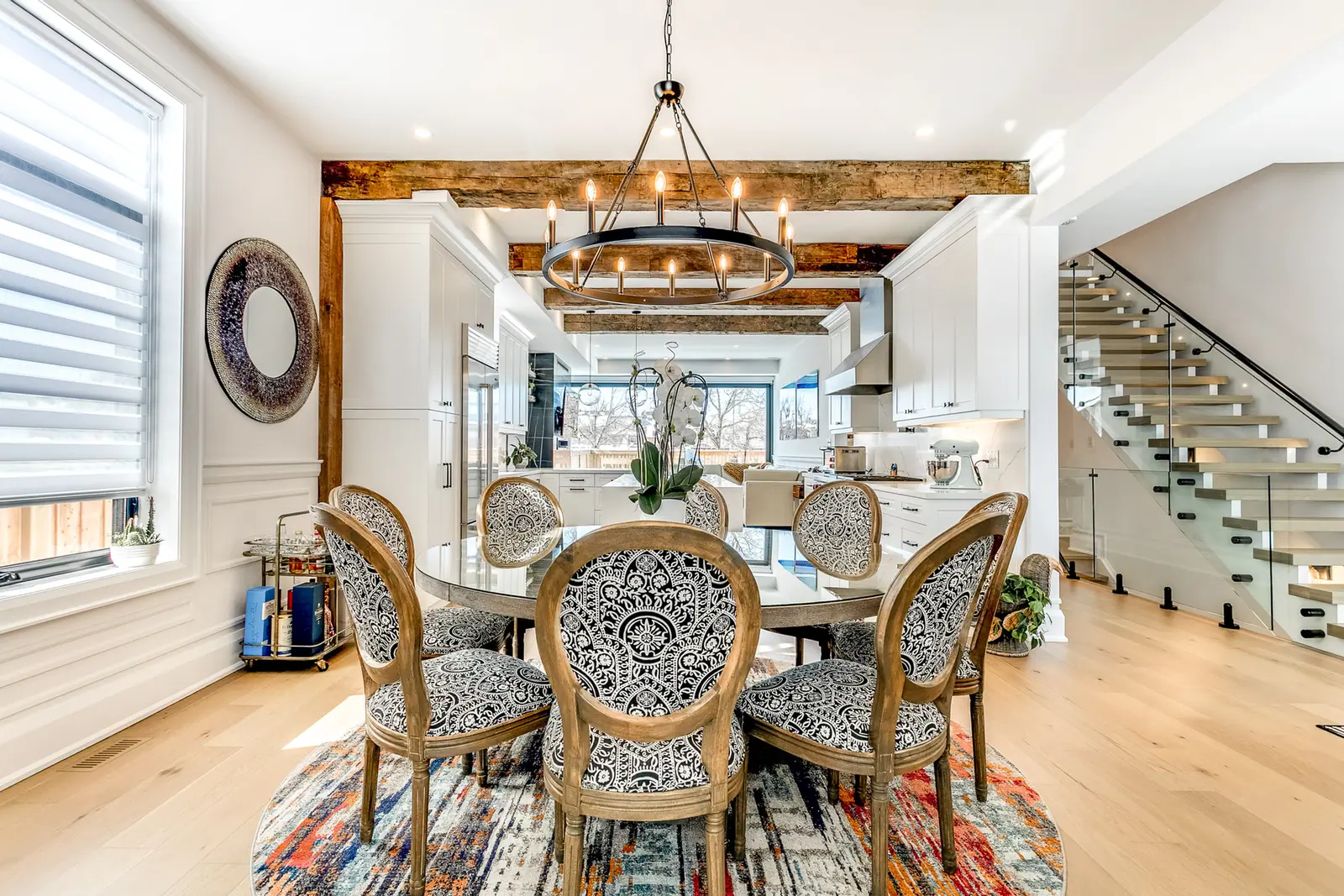
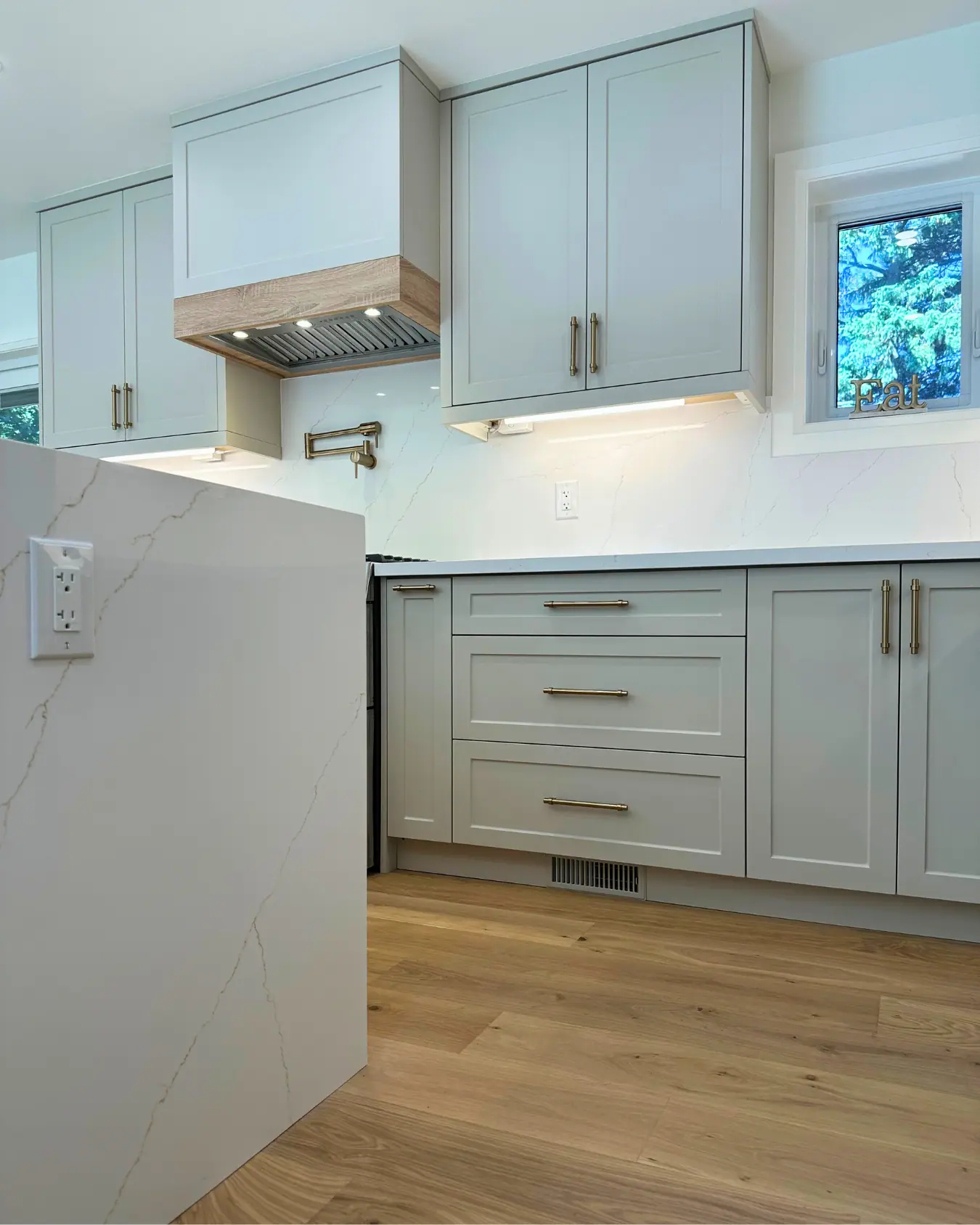
The modern kitchen renovation in Vaughan opened a family kitchen up for sightlines and used white oak throughout, including a full oak appliance wall with built-in appliances. A wall like that is the hardest test of a wood kitchen, because fridge and freezer panels, tall doors and drawer fronts all have to agree in colour and grain direction. Planning it means choosing the cut and the finish once for every panel and ordering appliance panels with the cabinets; see panel-ready appliances and integrated kitchens.
If you want both species, let one lead: a walnut island in a white oak kitchen, or walnut shelves against oak cabinets. Two wood tones that are close but not equal can read as a mismatch, while clearly different ones read as a choice; two-tone kitchen cabinets covers pairing finishes.
Questions
Is white oak or walnut better beside the sink?
Both are rated very durable against decay, and white oak's tyloses are why it has long been used for barrels and boats. In a kitchen the finish matters more than the species: a film finish on every edge, including the bottom edges of doors, keeps water out. White oak will also stain dark if wet iron sits on it.
Can veneered cabinet doors be refinished later?
Lightly. A scuff-sand and recoat works well, but veneer can be as thin as 0.64 mm, so heavy sanding goes through it. Deep gouges usually mean a new door or panel.
Will white oak cabinets turn yellow?
That depends mostly on the finish. Oil-based and linseed-based finishes warm and yellow pale woods, while water-based clear coats keep white oak lighter. The wood itself also deepens gradually with age and light, so judge samples that have been finished, not raw boards.
Is red oak a cheaper alternative to white oak?
It is usually a little cheaper and the grain is similar, but red oak has a redder cast and open pores without tyloses, so it lacks white oak's rot resistance. Under the same finish the two look different, so do not mix them on neighbouring doors.
Sources and further reading
- The Wood Database: White oak (Quercus alba)
- The Wood Database: Black walnut (Juglans nigra)
- The Wood Database: How wood finishes work
- The Wood Database: Preventing color changes in exotic woods
- Fine Homebuilding: A Buyer's Guide to Kitchen Cabinets
Checked November 19, 2026. Codes, by-laws, prices and product specifications change; confirm with your municipality, condo corporation or supplier before you build.
Keep reading
Related guides