Kitchen fixtures
Kitchen faucet buying guide
Choose a kitchen faucet for fit first, then function, then finish. Measure the space under any upper cabinet or window and how far the spout must reach to the centre of the bowl, match the number of holes to the countertop plan, and choose a pull-down or pull-out sprayer for how you rinse and fill. In Ontario, kitchen faucets must meet the CSA B125 plumbing fitting standards and are limited to 8.3 litres per minute.
What Ontario's Building Code requires of a kitchen faucet
Two rules apply to every kitchen faucet installed in Ontario. Article 7.2.10.6 of the 2024 Ontario Building Code requires supply fittings to conform to ASME A112.18.1/CSA B125.1 (or CSA B125.3), the North American standard for plumbing supply fittings, and to have a built-in means of limiting the flow rate. Table 7.2.10.6 sets that limit at 8.3 litres per minute for kitchen supply fittings in homes.
The number matches the United States: the U.S. federal standard for kitchen faucets is 2.2 gallons per minute (8.3 L/min) at 60 psi. So a faucet sold across North America is built to the same cap. The U.S. WaterSense label, often seen on bathroom faucets, has no criteria for kitchen faucets at all, so do not expect to find it.
In practice, 8.3 L/min fills a 6-litre stock pot in about 45 seconds at full flow. If that feels slow for big pots, a pot filler over the range is the usual answer, not a faster faucet.
| Supply fitting | Maximum flow |
|---|---|
| Kitchen faucet (homes) | 8.3 L/min |
| Shower head | 7.6 L/min |
| Private lavatory (bathroom) faucet | 5.7 L/min |
| Public lavatory faucet | 1.9 L/min |
Pull-down, pull-out, side spray or fixed spout
The sprayer style matters more day to day than any other feature, and the right one depends on the sink and what sits above it.
| Style | How it works | Suits | Watch for |
|---|---|---|---|
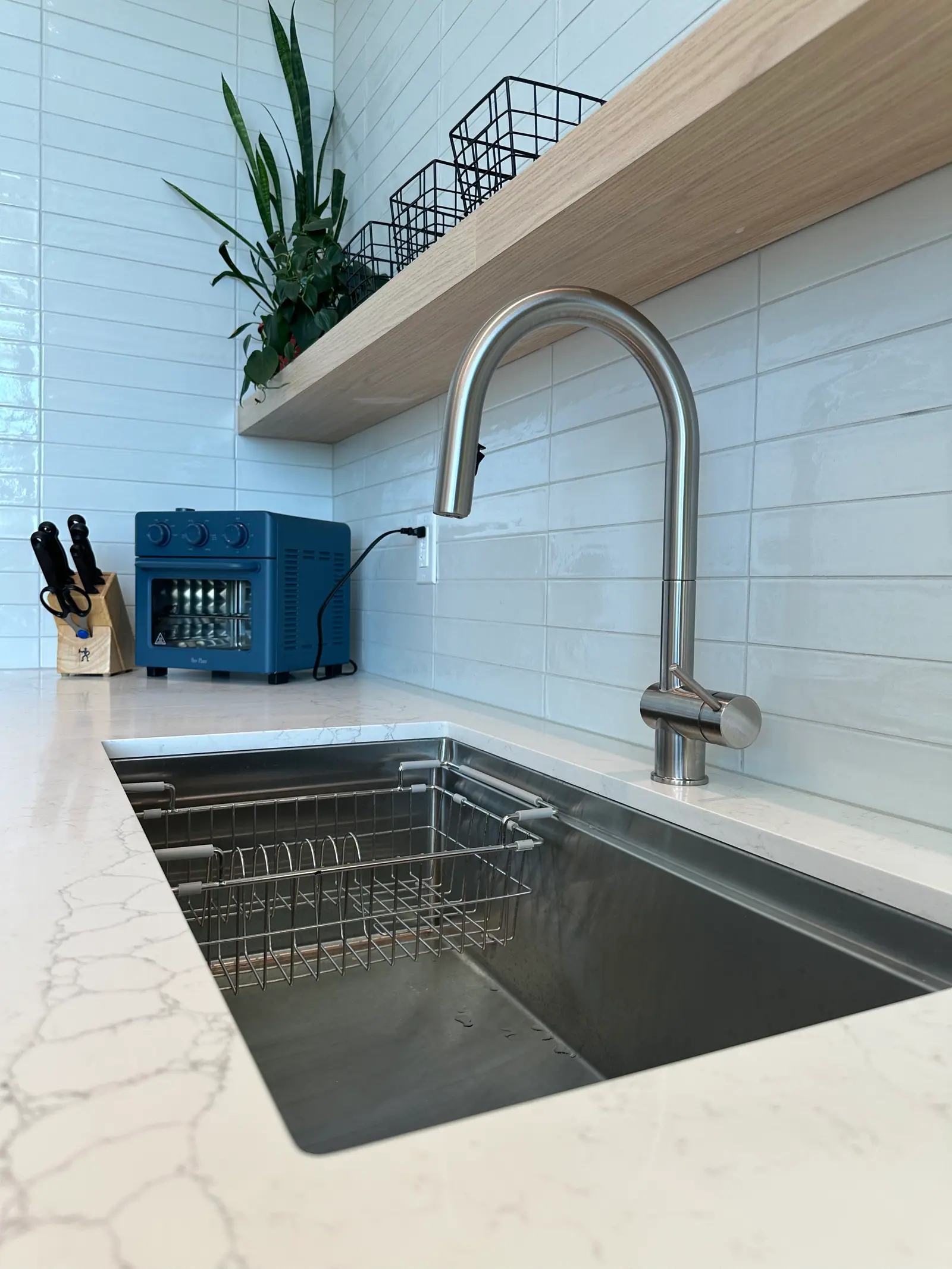
| Pull-down | Tall arched spout; the spray head pulls straight down into the bowl | Deep single bowls, rinsing large pots | Height under upper cabinets or a window sash |
| Pull-out | Lower spout; the head pulls out toward you | Filling pots on the counter, lower clearances | Shorter reach into a deep bowl |
| Side spray | Separate hand spray in its own hole | Traditional looks, two-handle faucets | An extra hole and a second hose |
| Fixed spout or bridge | No hose; bridge faucets have two handles joined by a bar | Heritage and farmhouse kitchens, prep sinks | Less flexible for rinsing |
| Touchless | An infrared sensor starts and stops the flow | Messy hands, busy cooks | Needs power from batteries or a plug-in adapter |
Measure height, reach and holes before you choose a faucet
Most faucet regrets are about fit. Builders Ontario's cabinet guide gives 18 inches as the standard gap between the counter and the upper cabinets, and a tall pull-down can come close to that once the handle is raised. A window behind the sink brings its own limit: check that the spout and handle clear the sill and any sash that swings or slides.
- Spout height: compare the faucet's overall height with the clearance above the deck, including the handle's full swing.
- Reach: the stream should land near the centre of the bowl or the drain. Too short and it splashes the back edge; too long and it hits the front.
- Handle clearance: a single lever pushed back needs room before a slab backsplash or a window sill.
- Hole count: one-hole faucets suit a clean deck; three- and four-hole layouts suit a separate spray, soap pump or filtered tap. A deck plate covers unused holes on an existing counter.
- Timing: on a new counter, holes are drilled in the shop or on install day, so choose the faucet before templating. Builders Ontario prices faucet holes at about $75.
- Island sinks: a high-arc spout is visible from the living room, so its shape matters more there. See kitchen sink placement.
Inside the faucet: the parts that decide how long it lasts
Most modern faucets use a cartridge rather than the rubber washer of older compression taps. In a ceramic-disc cartridge, two ceramic discs slide against each other to open and close the flow; Wikipedia's overview notes that these valves need far less maintenance than washer-type taps, and that when they do need service, the usual repair is a replacement cartridge. Ask whether replacement cartridges are sold separately for the model you are considering.
Faucet bodies are commonly made of brass for durability and corrosion resistance. At the tip, an aerator limits flow and mixes in air to reduce splashing; when flow drops on a faucet that used to run well, a clogged aerator screen is the first thing to check.
Under the sink, Ontario's code also covers the connectors: flexible water connectors under continuous pressure must conform to ASME A112.18.6/CSA B125.6 (Article 7.2.10.18). Ask for shut-off valves you can reach easily, so the faucet can be serviced without shutting off the house.
Finishes and matching them across the kitchen
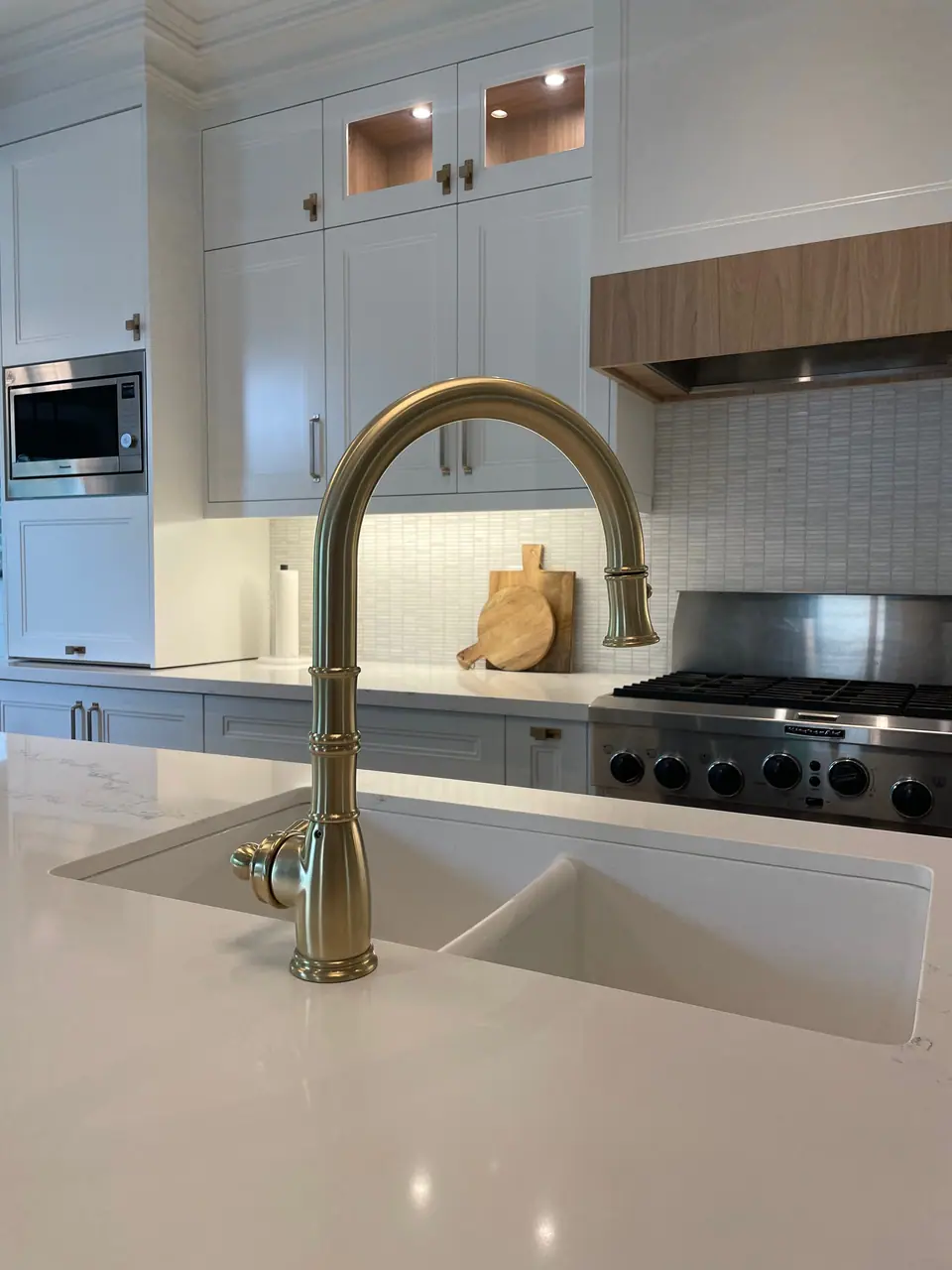
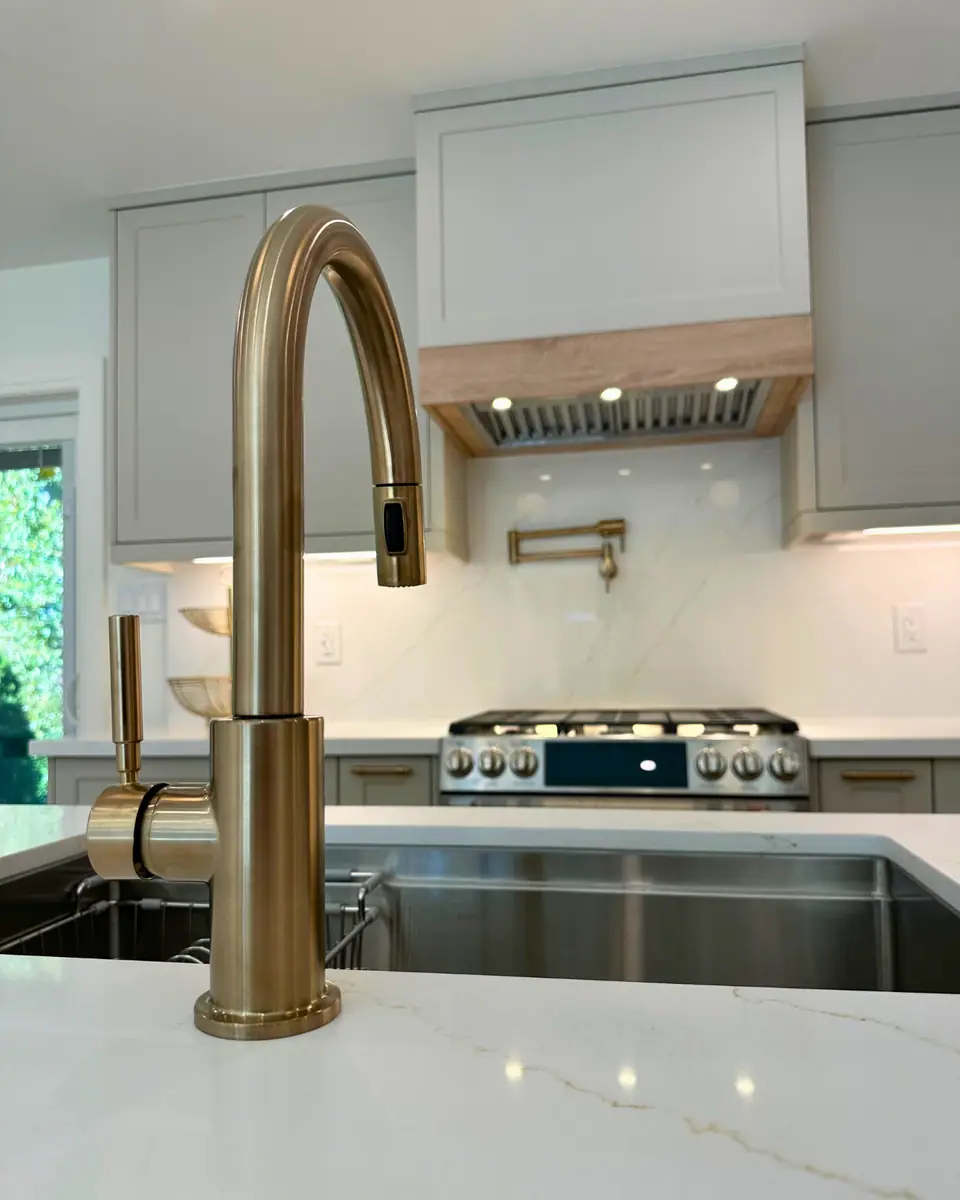
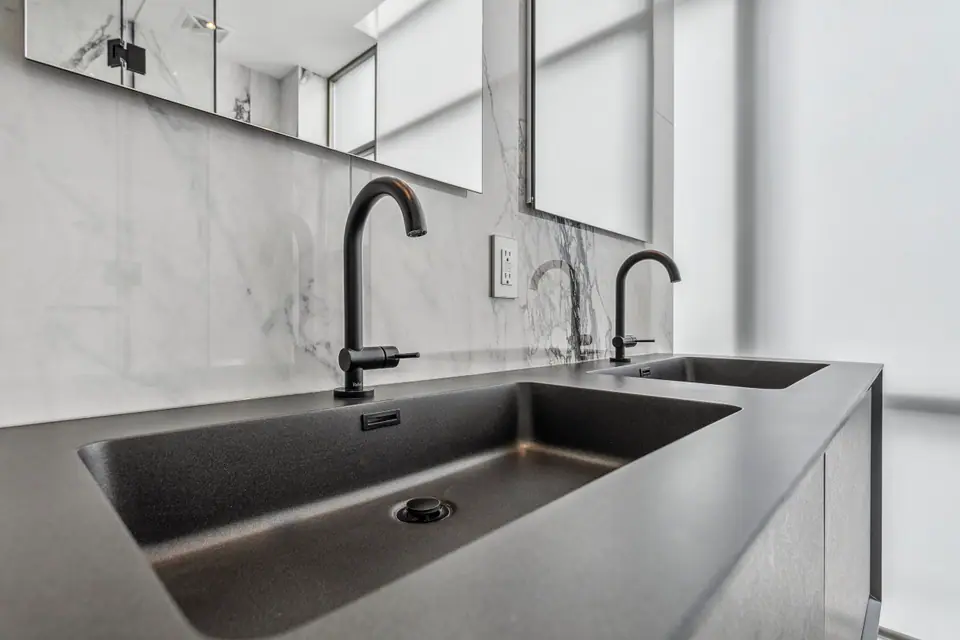
Chrome, stainless, brushed nickel, matte black and brass or gold tones are the common faucet finishes. Some finishes are applied by physical vapour deposition (PVD), a coating process used to improve hardness and wear resistance; ask whether the finish you like is PVD or a plated or painted coat, and read the maker's care instructions before using any cleaner on it.
The faucet does not have to match the cabinet hardware, but the two should look intentional together. The kitchen hardware finishes page covers pairing brass, black and nickel, and bathroom faucet finishes covers how brushed gold, matte black and chrome wear.
Extras that need a hole or a wall connection
Plan any add-ons with the faucet, because each one needs a hole in the counter or a connection in the wall before the counters are templated.
- Filtered water tap: a drinking water treatment device must conform to CAN/CSA-B483.1 under Ontario's code (Article 7.2.10.17). See water filtration and instant hot water taps.
- Instant hot water tap: usually needs a hole, a small heater tank under the sink and an outlet in the sink base.
- Soap dispenser: one hole, and a bottle that takes space in the sink cabinet.
- Pot filler: a wall-mounted faucet above the range, roughed in before the wall is closed. The Victorian kitchen and bathroom renovation in Milton pairs one with a professional range and a full-height quartz backsplash.
Questions
Why does a new kitchen faucet seem to run slower than the old one?
New kitchen faucets in Ontario are capped at 8.3 L/min, with an aerator or flow restrictor doing the limiting. If the flow is well below that, check the aerator screen for debris and the shut-off valves under the sink, which may not be fully open.
Is a touchless kitchen faucet worth it?
It helps when your hands are covered in raw meat or dough, and it reduces smudges on the handle. It needs power from batteries or an outlet in the sink base, so plan that outlet before the cabinets go in.
Can I put a one-hole faucet on a counter drilled for three holes?
Yes, with a deck plate that covers the extra holes. On a new countertop, drill only the holes you need so no plate is required.
Should a kitchen faucet match the cabinet pulls?
Not necessarily. Many kitchens use one metal for the faucet and another for the hardware. What matters is that the finishes look deliberate together and suit the sink and countertop.
Sources and further reading
- Ontario 2024 Building Code Compendium, Part 7: Plumbing (Article 7.2.10.6 and Table 7.2.10.6)
- 10 CFR 430.32, U.S. energy and water conservation standards (faucets)
- U.S. EPA WaterSense: Bathroom faucets (no criteria for kitchen faucets)
- Wikipedia: Tap (valve)
- Builders Ontario: Standard kitchen cabinet dimensions
Checked November 19, 2026. Codes, by-laws, prices and product specifications change; confirm with your municipality, condo corporation or supplier before you build.
Keep reading
Related guides